Wind costs most golfers more strokes than their swing does — because their instincts are wrong. Here's how wind actually affects ball flight.
.jpg)
Track your rounds, compare courses, and unlock data-driven improvement.
Download TangentWind costs most golfers more strokes than their swing does — not because it's hard to play, but because their instincts are reliably wrong. Here's what actually happens to a ball in wind, the mistakes adding strokes to your card, and the strategy that fixes them.
A 15 mph headwind can make a 150-yard shot play 170. A hard crosswind can push a perfectly struck approach 25 feet offline. And yet most golfers step up to a windy shot and trust their gut — a gut that, across decades of shot-tracking data, is wired to be wrong. This isn't a talent problem. It's an understanding problem. Once you know how wind actually works on a golf ball, it stops being a guessing game.
Three factors determine how much wind affects any given shot: the direction it's blowing, its speed, and the amount of time your ball spends in the air. The third one is the least intuitive and the most important.
A high-spinning wedge stays airborne longer than a driver. A ballooned mid-iron hangs longer than a penetrating one. The longer the ball is up there, the more wind acts on it. This is why flighting the ball down into the wind isn't just a swing cliché — it's physics working in your favor.
Headwinds hurt more than tailwinds help. It's not symmetrical. And this asymmetry is the single most important thing to understand about playing in wind.
Here's why. Into a headwind, every imperfection in your strike gets amplified. Backspin climbs the ball higher, which exposes it to more wind for longer. A slightly open face adds sidespin that curves more. The wind is fighting the physics of your shot the whole way down.
A tailwind, by contrast, flattens ball flight and strips spin. A tailwind helps — but physics caps how much. You can't reduce spin below zero or launch the ball faster than your clubhead allows. So the "benefit" is always smaller than the "cost" at the same wind speed.
Crosswinds — the most ignored category in amateur golf — are the most deceptive. That 15 to 25 feet of drift on a mid-iron is the difference between a makeable birdie putt and a chip out of a bunker. And unlike with a headwind, you don't need to mis-hit to suffer the damage. All you have to do is aim at the flag and let the wind do its work.
Pull up shot-tracking data across handicap levels and the same wind-related mistakes surface everywhere. The difference is that amateurs make them more often and pay more per mistake.
The single most common wind mistake in amateur golf. Golfers feel "some wind," take one extra club, and come up short. They forget that wind is stronger at ball-flight height — 50 to 100 feet up — than it is on the ground. A 10 mph breeze at your feet can be an 18 mph wind where the ball is actually living.
The mirror-image mistake. Because a tailwind does help, golfers over-rotate on the expectation — dropping two clubs when they should drop one. The result: landing short of the pin, confused why the wind didn't carry it.
Many golfers aim at the flag in a 10 mph crosswind and hope for the best. Even a perfect strike ends up 20 feet wide. If you track your greens in regulation across windy days, you'll see a pattern: shots don't miss long or short — they miss left and right, and the player blames "bad approach play" when the real problem was aim.
Possibly the most destructive instinct in amateur golf. The intuition says: it's windy, so I need more power to push through it. The reality: harder swings produce more spin, which launches the ball higher, which exposes it to more wind for longer, which makes it travel shorter. Into the wind, smoother is longer. "Swing with ease into the breeze" is a cliché because it's true.
A scratch golfer changes shot type based on wind. A knocked-down 7-iron into a headwind where they'd normally hit an 8. A lower-trajectory 4-iron off a windy par 4 tee. A higher, softer landing on a downwind short iron. A 20-handicap hits the same shot every time and watches the wind dictate the outcome.
Tour caddies — people who play wind for a living — approach it with three habits most amateurs don't.
They measure before they estimate. A good caddie doesn't guess "it's probably 15." They read pin flags, tree tops, cloud speed, dust, their weather app. They triangulate. They're skeptical of how wind "feels" on the ground, because the ground is where wind is weakest.
They respect the asymmetry. When a caddie gives a yardage in wind, they've already done asymmetric math — more club for headwinds, only slightly less for tailwinds. It's not a feel thing. It's a rule.
They aim at landing spots, not pins. In a crosswind, the target isn't the flag. The target is wherever the ball has to start to let the wind bring it back. Every approach becomes a two-part calculation: where the ball needs to land, and where you have to aim to get there.
Knowing the right answer is useless if you can't do the math over a ball while the wind is actively changing. That's the problem Tangent is built to solve.
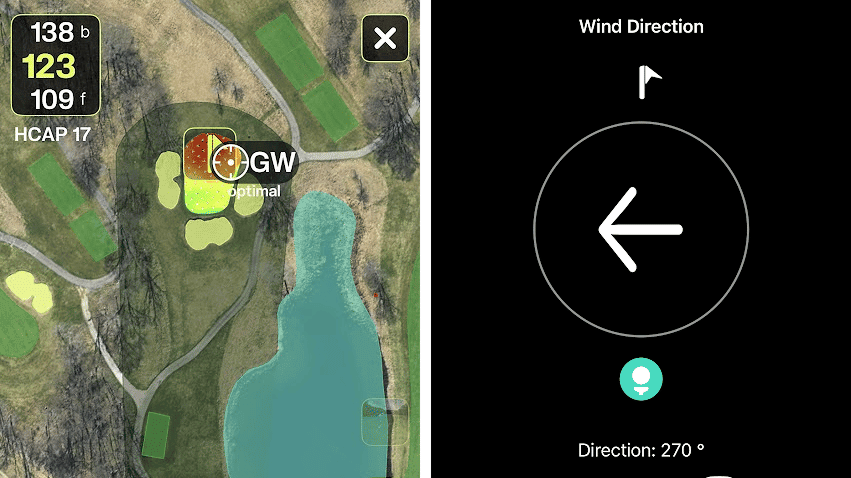
Tangent integrates live wind data into every shot. The plays-like yardage you see on screen has already factored in current wind speed and direction — you're not calculating in your head, you're reading a number. The AI Caddie takes it further: it combines wind-adjusted yardage with your personal shot dispersions and the specific layout of the hole, then recommends a club and aim point that minimize your actual risk given the conditions.
Wind on a course rarely matches the reading at the nearest weather station. Gusts, swirls, tree lines, elevation changes — they all shift what's happening above your ball. Tangent's Wind Adjustment lets you manually override wind speed and direction mid-round. Dial in what you're actually feeling, tap done, and every yardage and every recommendation updates instantly.
The net effect is that wind stops being a source of bias and becomes a source of information. You're still the golfer hitting the shot. Tangent just makes sure the shot you're hitting is the right one.
Playing well in wind isn't about more talent or a better swing. It's about better information and the discipline to trust it.
The golfers who shoot their normal number in 20 mph wind aren't stronger or more skilled. They've just stopped guessing.
Join thousands of golfers getting course strategy, swing tips, and data-driven insights from Tangent delivered to their inbox.


