Strike is King: Why Golf Impact Location Determines Everything
Your swing looks great — so why is it so inconsistent?
If you’re tired of mystery misses and inconsistent distances that make club selection feel like a guessing game, the culprit isn’t your swing plane or your grip. It’s your golf impact location — the precise point on the clubface where the ball makes contact. This single variable controls your distance, your spin, and your ability to score more than any other factor in the game.
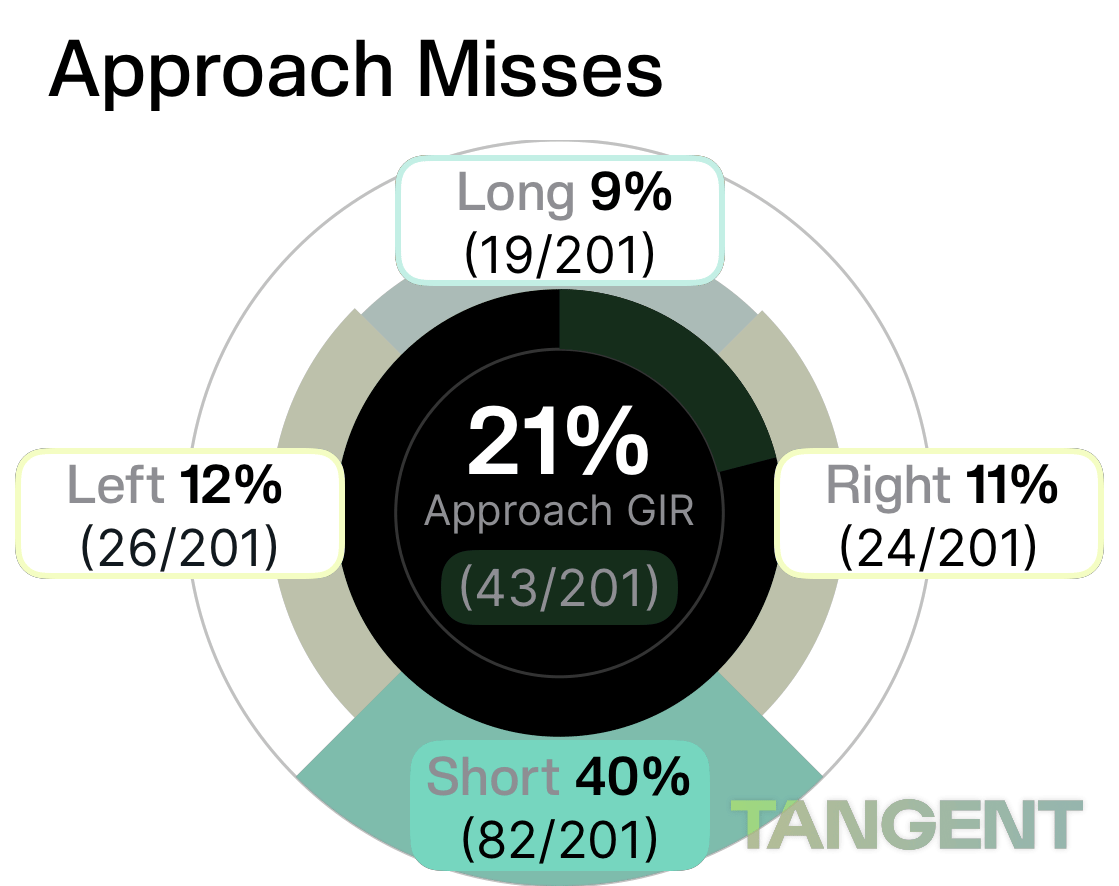
Most golfers chase swing fixes — a new grip, a different backswing, a YouTube tip. But the data tells a different story. When we analyzed thousands of rounds tracked by Tangent golfers, strike quality was the single strongest predictor of consistency. Golfers who hit the center of the face more often hit more greens, lose fewer balls, and shoot lower scores — without changing anything else about their swing. The stats that actually correlate to breaking 90 back this up.
The Symptoms: Are You Dealing With These?
Before you try to rebuild your backswing, check whether any of these sound familiar:
**The Short Miss:**You consistently hit the ball shorter than your potential. Off-center contact bleeds ball speed — you’re leaving real distance on the table every time you swing.
**The Hook Bias:**Persistent draws or hooks (for a right-handed golfer) are often the physics of a toe-biased strike, not always a swing path problem.
**The Fade Bias:**Weak fades and push-blocks that won’t hold a line are frequently amplified by heel contact.
**The Twist and Sting:**Your hands sting after a shot or the club twists in your grip. That’s energy going into your hands instead of the ball.
**Thin or Fat Contact:**Catching the ball too low on the face (thin) or hitting the turf before the ball (fat) both signal a vertical strike location problem.
If any of those sound familiar, you don’t have a swing problem — you have a strike location problem. And that’s actually good news: it’s measurable, and it’s fixable.
What Is Golf Impact Location?
Golf impact location is the precise coordinate on the clubface where the ball makes contact at the moment of impact. We call this the Tangent — the exact point where your swing arc meets the clubface. Impact location is measured on a two-dimensional grid:
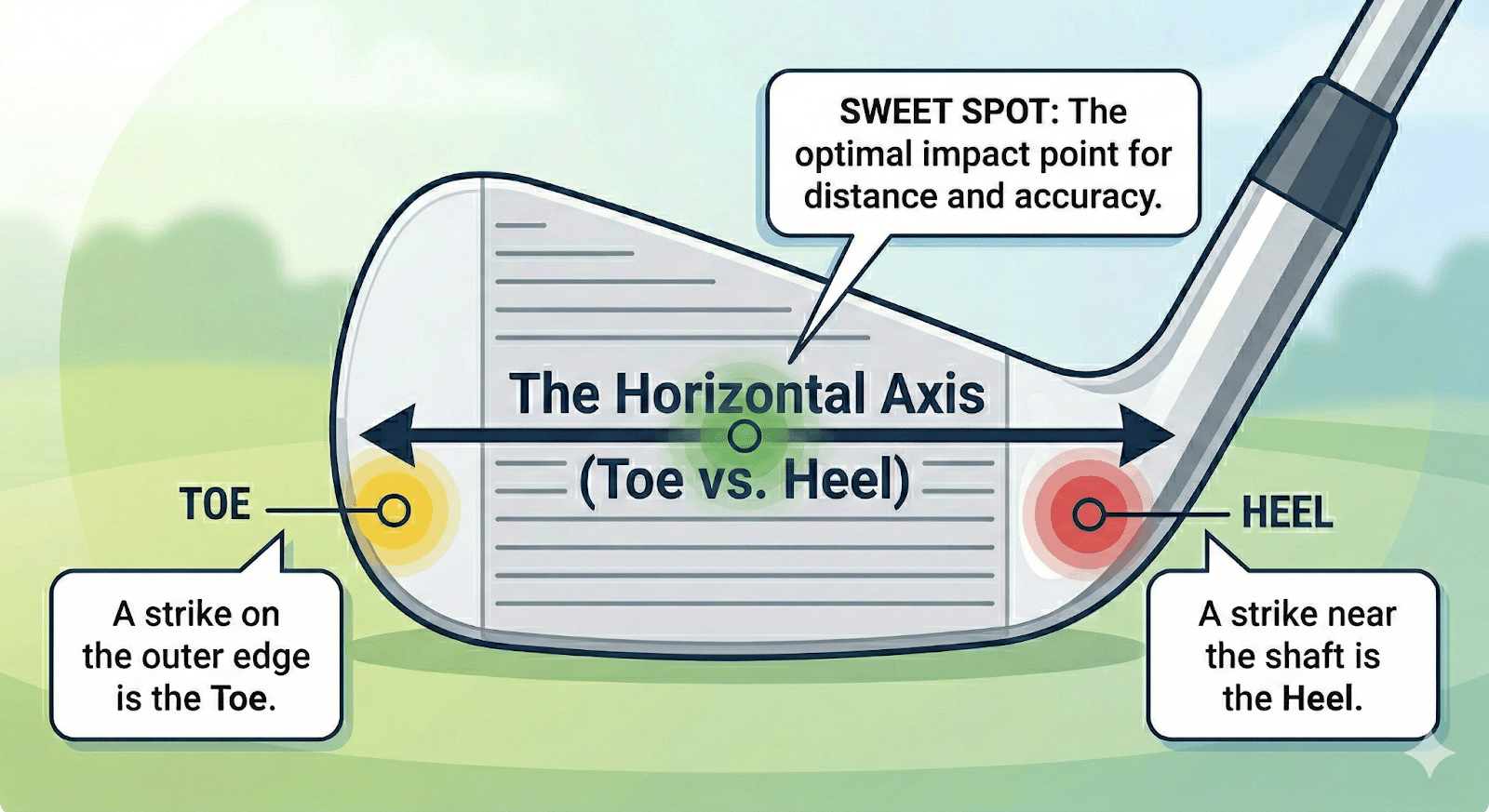
- **Horizontal (Toe vs. Heel):**Side-to-side position. The toe is the outer edge of the face; the heel is closest to the shaft.
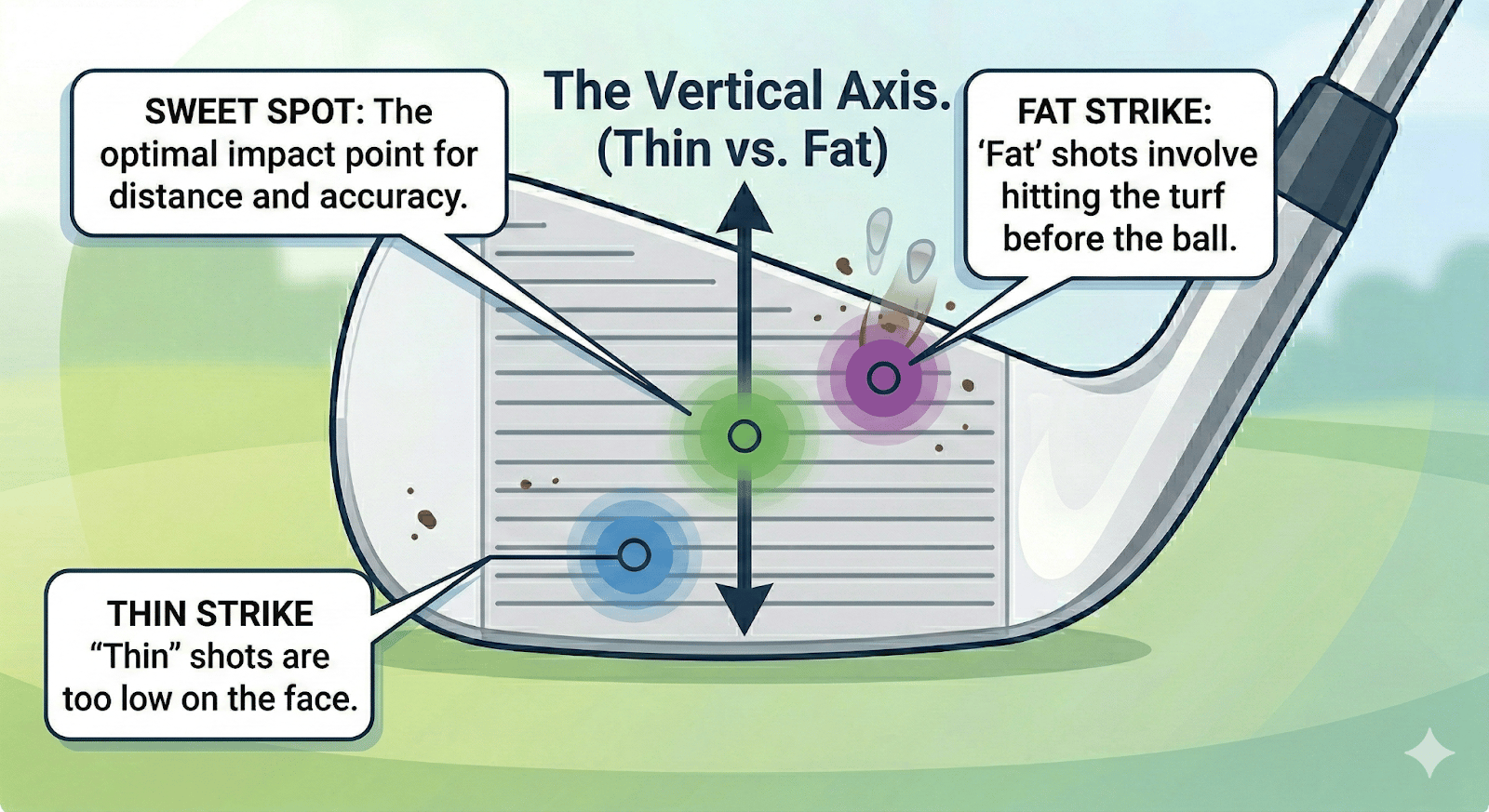
- **Vertical (High vs. Low):**The height of contact. Strikes too low on the face are thin; hitting the turf before the ball or hitting high on the face is fat.
- **The Sweet Spot:**Dead center — the club’s center of gravity, where energy transfer to the ball is at its maximum.
Every shot you hit lands somewhere on that grid. The question is: do you actually know where?
Why It Matters: The Ultimate Arbiter of Every Shot
The golf ball doesn’t know what your swing looks like. It only reacts to the physics of the collision at the Tangent. That single point of contact controls almost every outcome:
**Distance and Smash Factor:**A center strike with a driver produces a Smash Factor of 1.50 — the maximum legal efficiency of energy transfer. Move just half an inch off-center and that can drop by 15%, costing you 30+ yards instantly.
**The Gear Effect (and “Swing Faults” That Aren’t):**A toe strike twists the clubhead open at impact, imparting hook spin. A heel strike twists it closed, producing slice spin. Many golfers spend months “fixing” a path issue that is actually just the gear effect responding to a strike pattern.
**Consistency:**Tighter strike location turns your bad shots into functional shots. You don’t need a perfect swing — you need a predictable one.
The fastest path to lower scores isn’t a new swing. It’s knowing — and then shrinking — your miss. Shrinking your miss is how you hit more greens and hitting more greens is the key to your scoring goals.
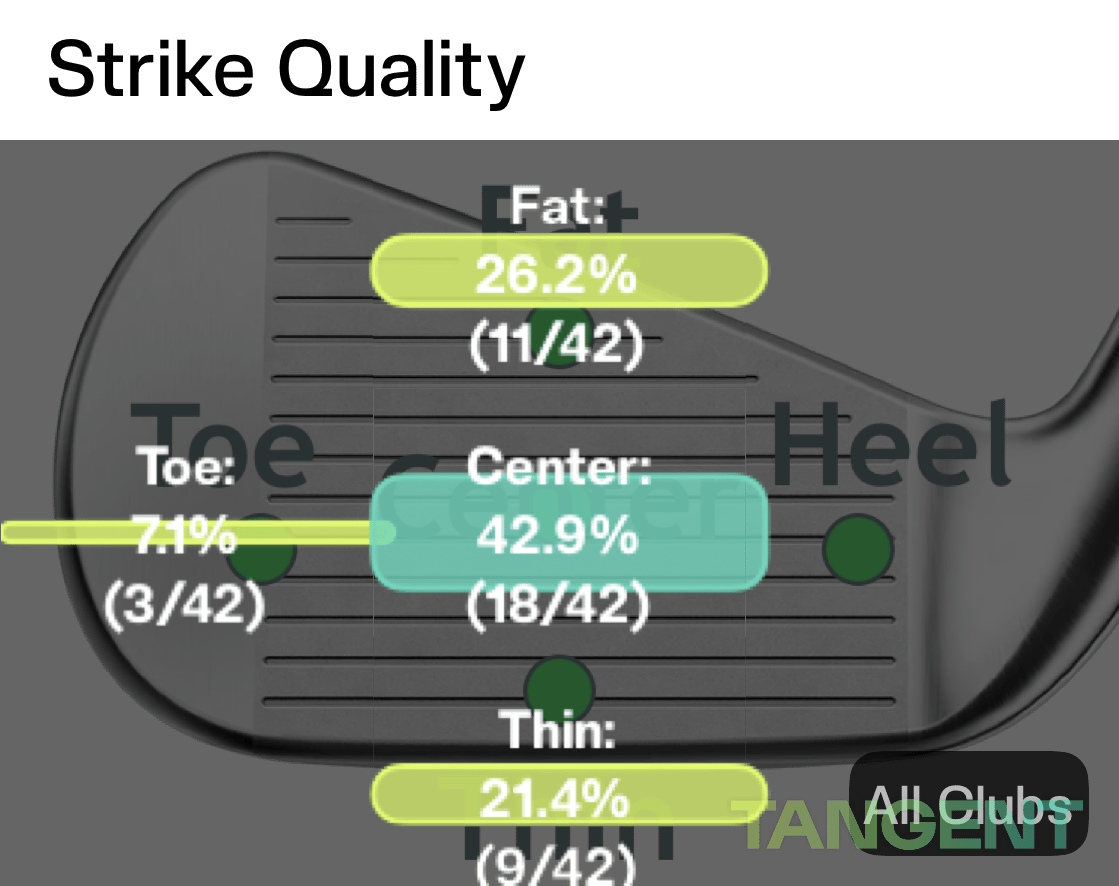
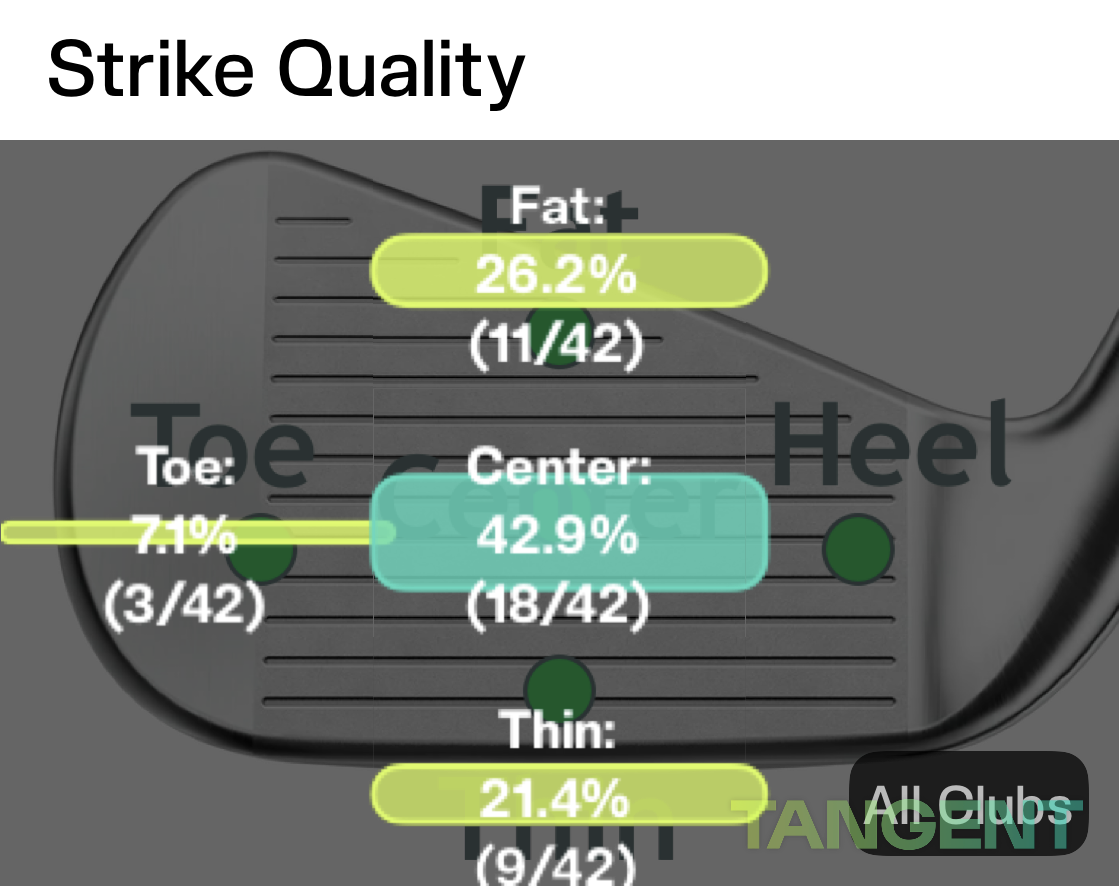
Strike Quality as measured by Tangent in the Round Report
How to Track and Improve Your Impact Location
You cannot fix what you cannot measure. Training your ability to detect impact location without the need for tools is critical. The feedback from the sound of impact and the vibration in your hands is often enough to tell your brain exactly where impact occurred with a little bit of training. Here is how to use simple tools to train that skill so that on the course, you’ll know exactly where you hit it on the face without looking.
Here’s how to train this skill:
1. Visual Feedback on the Range
**Foot Spray:**A thin layer of aerosol foot powder on your clubface gives you an instant white imprint of every strike. Cheap, immediate, and often eye-opening.
**Impact Tape:**Adhesive strips applied directly to the face leave a dark mark exactly where the ball compressed. Cleaner than spray and easy to photograph to review your patterns over time.
2. Log Every Shot with the Tangent Golf App
Visual tools show you where you struck it, but by the time you’ve completed a round or a bucket of balls, you will have forgotten the trends and the hard numbers of your performance.
“I think I hit most on the toe” is not a good answer.
We can improve what we can measure.
The Tangent Golf app lets you log your impact location for every shot during a real round or in practice— building an honest record of your true miss patterns and tendencies.
*Most golfers are surprised by what the data shows.*You might remember one bad hosel rocket, but your actual data might reveal you hit the toe 70% of the time. Once you know your true miss, Tangent’s built-in Impact Drill in the Practice section targets your specific bias with purpose-built feedback loops — so every range session is working on the exact thing you need to fix. Each time you do the drill, your impact locations are saved so that you can track your progress from round to round and practice to practice. See those center strikes increase and your misses improve.

Click to see the impact drill in action
3. Still Struggling to Find the Center - Try the Gate Drill
If you find yourself missing consistently on one side, adding an object to avoid can be the ticket to center contact.
If you have a Toe biased miss, try adding a tee in the ground just outside the heel of your golf club. In order to miss the tee, you will have to move the strike away from the toe and towards the center.
If you have a Heel biased miss, try adding a tee in the ground just outside the toe of your golf club. Now to miss, you will have to move the strike away from the heel and towards the center.
Want to make it even more difficult?
Place two tees in the ground slightly wider than your clubhead. Swinging through the gate without disturbing either tee trains your brain to self-organize a centered strike path.
Simple, low-tech, and highly effective when paired with our TRACER framework for building better golf habits.
4. High-End Launch Monitor Data
For the most precise measurements available, photometric monitors like the Foresight GCQuad or radar units like the FlightScope Mevo+ (with Face Impact Location) track strike to the millimeter. These are exceptional tools for serious practice environments. Pair them with the Tangent Golf app in practice and for on-course tracking and you have a complete picture of your strike pattern from range to round.
What Does “Good” Look Like?
It’s a myth that professional golfers hit the dead center of the clubface every single time. They don’t. What separates a tour player from an amateur isn’t perfection — it’s the size of the miss.
Elite ball strikers have shrunk their definition of center. While an amateur’s strike pattern can look like a shotgun blast across the entire face, a tour pro’s pattern typically fits inside a nickel. Their bad shots are still close enough to good to stay in play.
That’s the goal: not a perfect strike every time, but a tighter circle. When your misses are small, your bad shots become functional shots. The golfers who improve fastest aren’t the ones who hit more balls — they’re the ones who get more out of the balls they hit.
Ready to stop guessing?
The Tangent Golf app lets you log your impact location on every shot - on the range and on the course. See your real patterns, identify your bias, and fix it with the built-in Impact Drill.
→ Download Tangent Golf - Free
Frequently Asked Questions
What is impact location in golf?
Golf impact location is the specific point on the clubface where the ball makes contact during a swing. It is measured on a two-dimensional grid: toe-to-heel (horizontal) and high-to-low (vertical). The center of this grid — the sweet spot — produces maximum energy transfer and ball speed. Off-center contact reduces distance and distorts direction through the gear effect.
How does strike location affect golf distance?
Strike location directly affects Smash Factor — the ratio of ball speed to clubhead speed. A perfect center strike with a driver produces the maximum Smash Factor of 1.50. Moving just half an inch off-center can reduce efficiency by 15%, costing 30 or more yards of carry. Most recreational golfers significantly underestimate how much distance they lose to off-center contact. So before you blame your equipment, check your strike pattern.
What is the gear effect in golf?
The gear effect describes how off-center strikes influence the spin axis of the ball. A toe strike twists the clubhead open at impact, imparting hook spin. A heel strike twists it closed, producing slice spin. This is why many persistent hooks or slices are actually the physics of a strike pattern rather than a swing path error. Fix the strike location first, then reassess.
What is a good Smash Factor in golf?
For a driver, the maximum Smash Factor allowed under the rules of golf is 1.50. Tour professionals average between 1.48 and 1.50. Most recreational golfers average between 1.40 and 1.45, meaning measurable distance is being left behind on every drive. Improving center contact through deliberate impact location training is the fastest path to better Smash Factor without changing equipment. Maximum smash factor will naturally decrease as you move through the bag.
How do I find my true miss pattern on the golf course?
Range feedback tools like foot spray and impact tape reveal your strike pattern in practice, but they rarely reflect real on-course performance. The most accurate way to identify your true miss is to track your strike location during actual rounds. The Tangent Golf app is built exactly for this — log each shot’s impact location during a round, and review your patterns over time to find and fix your actual bias.
How can I tell if I'm hitting the center of the clubface?
The cheapest method is foot spray or Dr. Scholl's Odor-X — spray it on your clubface and hit a ball. The mark shows exactly where you made contact. Impact tape works the same way but is cleaner. For on-course tracking over time, the Tangent Golf app lets you log your impact location on every shot so you can see your true miss pattern across full rounds, not just a few range balls. For the highest precision, launch monitors like the Foresight GCQuad track strike location to the millimeter.
Does strike location matter more than swing path?
For most amateur golfers, yes. Swing path gets all the attention, but off-center contact has a larger effect on both distance and direction than most path errors. A centered strike with an imperfect path will almost always produce a better result than a perfect-path swing that misses the sweet spot by half an inch. Fix your strike first, then fine-tune your path — you may find the path issues partially resolve on their own.