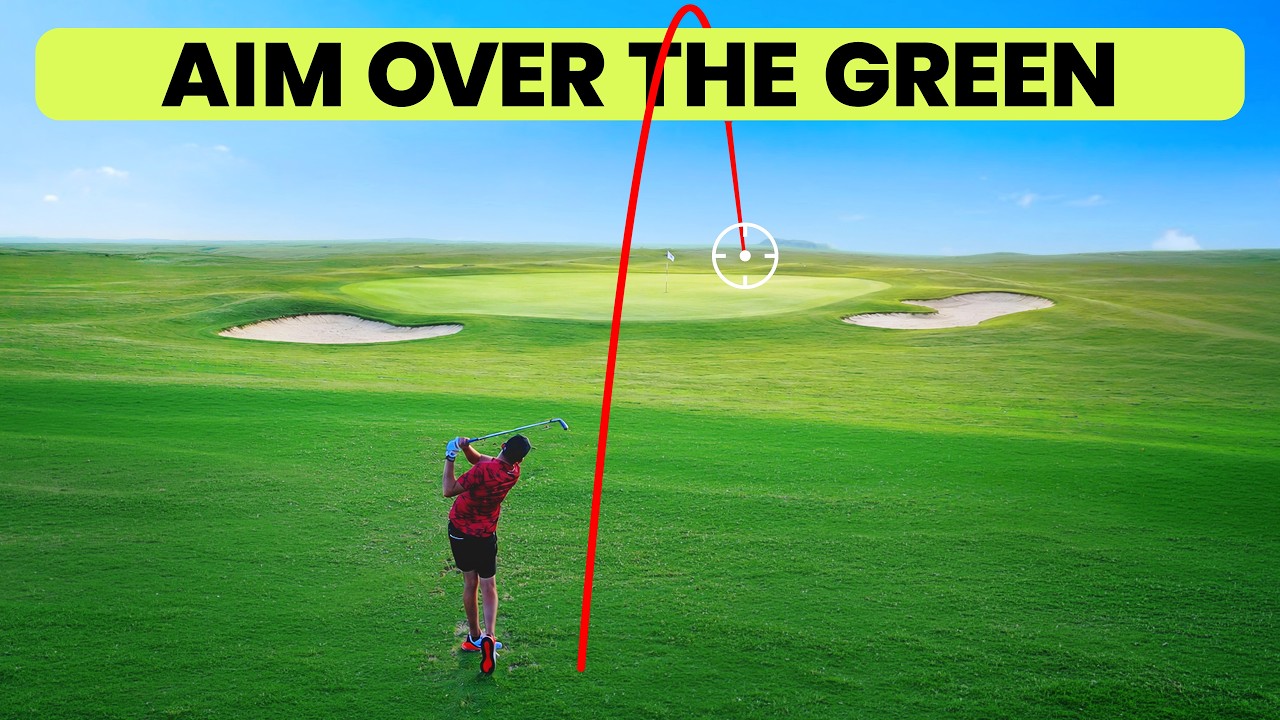
Amateurs miss short up to 54% of the time. The fix isn't a better swing — it's a better target.
Here's some advice that sounds insane: in your next round, try to hit your approach shots over the green.
I don't actually want you airmailing greens into the back bushes. But golfers miss short so often, and by so much, that for most of us aiming at the back of the green would produce lower scores than aiming at the center.
The culprit is a shot that barely exists. Perfect lie, flat stance, no wind, dead center of the face. You've hit it. You told your buddies about it for a week.
And that fantasy number is quietly costing you more strokes than your driver, your putting, or your short game.
Watch the Full Breakdown
Watch the full video on YouTube
Dallas shows the dispersion data and the target shift on course. Everything below is the written version.
Your 7-Iron Isn't a Number. It's a Range.
Quick test. How far do you hit your 7-iron? Say it out loud.
Now — was that carry or total? I never specified. Your brain grabbed one and handed it over as if they're the same thing.
If you pictured total, that's carry plus rollout. It's useless for clearing a bunker, because a bunker doesn't care where the ball stops. It cares where it lands.
If you pictured carry, that's better. But without a launch monitor you don't reliably know your carry, it changes with elevation, and you're almost certainly quoting your best strikes.
Carry gets you over the trouble. Total decides where you stop. You need both.
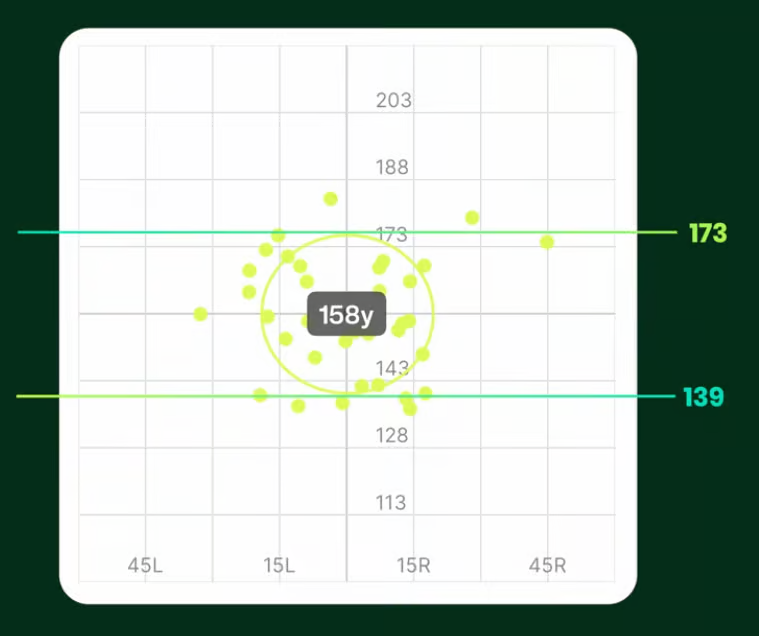
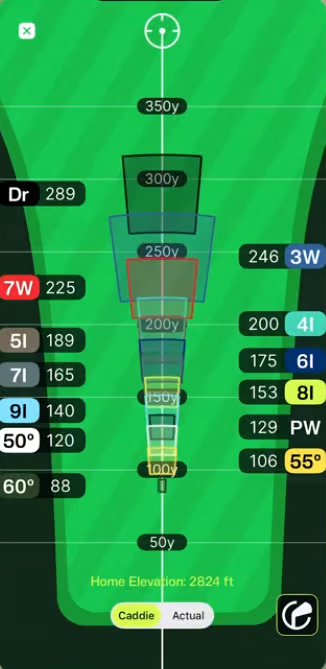
Your 7-iron starts at a carry you're confident of on a mediocre strike and extends to the total on your best one. That's a range, not a number — and it's generous, because it comes from perfect lies off a mat.
Short Is the Default Miss
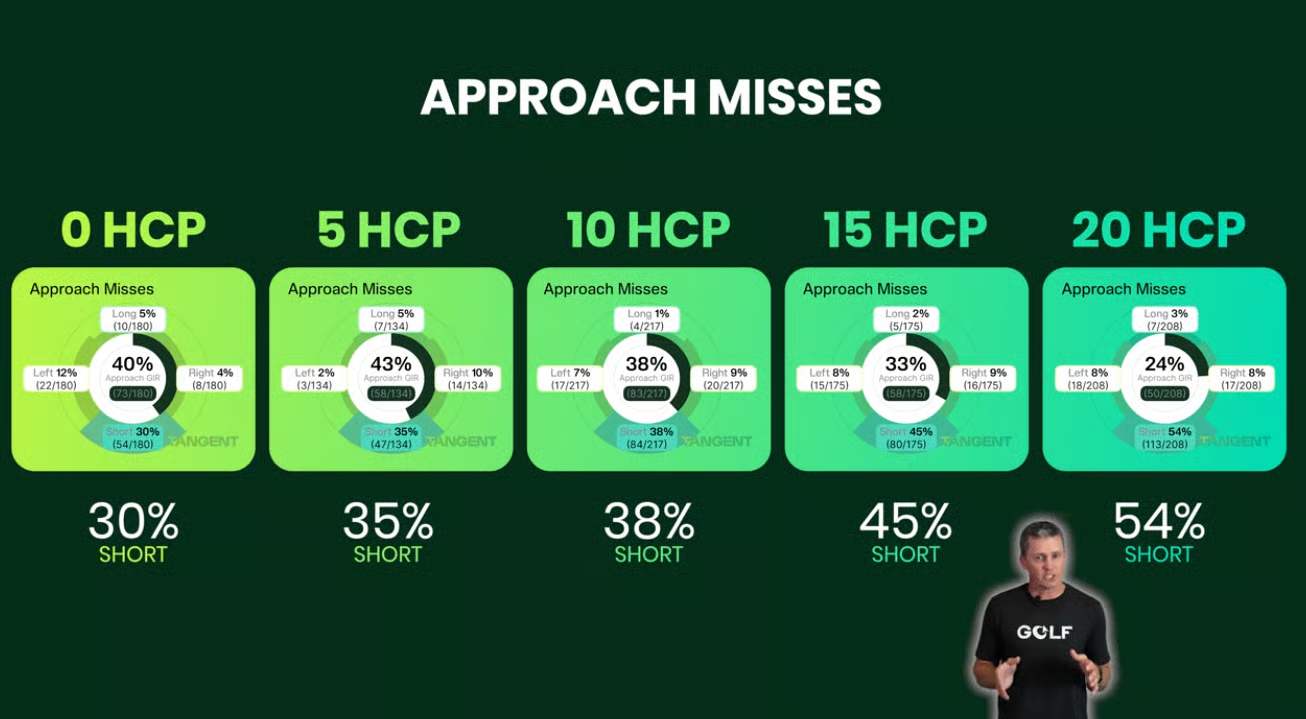
I'm a scratch handicap. In a recent round, when I missed a green I missed it short more than 30% of the time. I rarely missed long. I lost four strokes on approach to an elite amateur.
Walk down the handicap ladder and the pattern doesn't change — it gets more extreme. Across 10 million shots in the Tangent database, amateurs miss short more than any other direction: from 30% at scratch to 54% at a 20 handicap.
Long is rare for everybody. So the question isn't whether you come up short. It's why.
The Six Ways You Come Up Short
1. You overestimate your distance
You plan off your best-ever carry. That's like planning your commute assuming every light is green — you'll be late every day.
The fix: find the carry you beat seven times out of ten and club off that. Don't know it? Treat the number you said earlier as your maximum, not your average.
2. You don't account for mishits
You clubbed for a flush strike, but flush is the exception. This is budgeting your month assuming zero surprise expenses. The surprise expense isn't a surprise — it's Tuesday.
The fix: club for your good miss. Center-face contact should be the bonus that flies it to the back of the green, not the requirement to reach the front.
3. You don't account for the lie
Every ball you've hit on a range sat on a perfect surface. That's your empty-gym free throw number. The course is a packed arena.
The fix: read the lie before you pick the club. Down in rough, above your feet, on a downslope — each costs distance and predictability. From any compromised lie, play longer and aim at the fat part.
4. You misjudge the wind
You underestimate the hurt and overestimate the help. Into the wind is walking up a down escalator: the ball climbs, spin increases, and it catches even more wind. Downwind is a gentle shove that also kills the spin you need to hold the green.
The fix: treat wind as asymmetric. One club of hurt, take two and swing easier to keep it down. Two clubs of help, take one and plan for it to land short and release.
5. You ignore slope
When the green sits above you, you play the flat number and come up the hill short. You already know how to fix this — throw a ball to someone on a balcony and you instinctively throw harder and higher. You just don't do it with a club in your hand.
The fix: stop trusting slope mode to rescue you. It's a rough guess that knows nothing about your trajectory, your spin, or the wind.
6. You're thinking total, not carry
The big one.
You think 165. But that's total. On the course you'll walk up five yards short of a 170 pin and conclude you hit it 165 — when it actually landed at 155 and rolled ten. That ten yards is everything when you have to carry a bunker or a false front. And a soft green won't give you the rollout your number assumes.
The fix: know both numbers and pick the one the shot is asking for. Danger in front, plan with carry. Open and firm, total matters. The mistake isn't picking the wrong one — it's only ever knowing one.
They Stack
Individually each of these costs a few yards. But they don't arrive one at a time.
A single approach can be uphill, into the breeze, out of the rough, with a slightly heavy strike. Stack those on a best-ever number and you're not a few yards short.
You're two clubs short. All round long, without ever noticing.
The Puddle Test
The fix is annoying, because you already do it everywhere else in your life.
Picture a puddle you have to jump. Do you calibrate your run-up to just barely reach the far lip, where being off by 2% means wet feet all day?
Of course not. You jump like you mean it. You build in margin without thinking, because the cost of short is catastrophic and the cost of long is one extra step.
Golf is the same math. Short is the water, the front bunker, the false front, the chip up the hill. Long is usually a clean lie and a putt back toward the hole.
Move Your Target, Not Your Swing
When you aim at the flag, your entire real dispersion tends to live short of that target. You've anchored your pattern to the wrong point, and the front of it falls into the bunker.
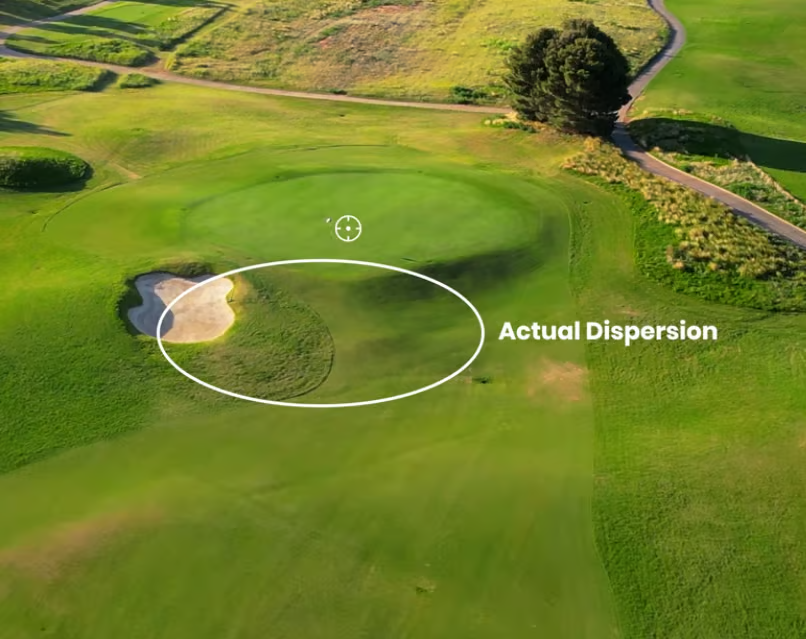
Move your aim to the back center. Same swing, same dispersion — but now the misses are on the green.
I didn't get better at golf. I moved my target to where my shots actually go.
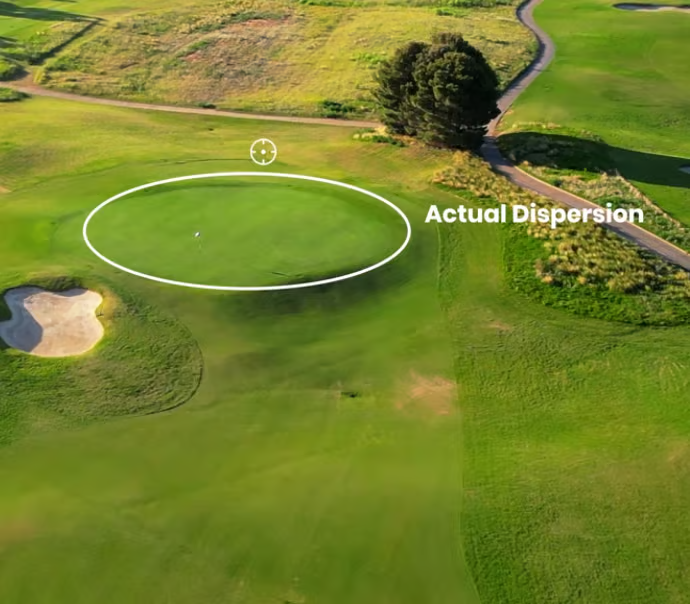
That's what "aim over the green" really means. Not flying it into trouble, but refusing to anchor to a point your pattern can't reach.
And it isn't simply "always take more club." That's the caveman version. The real answer is target selection based on your pattern and the shape of the green, which is the same dispersion thinking behind breaking 80. Front pin behind a bunker? Your target is the fat part past the sand. Back pin? Now you really do want that back number.
The pin is almost never your target. Your target is wherever the center of your dispersion loses the fewest strokes.
This isn't a you problem either. Front pins produce some of the most missed greens on tour — not because pros can't hit it close, but because a front pin behind a bunker baits them into a number their dispersion can't safely cover. The best of them do the boring thing and aim past it.
If the number one player in the world isn't firing at a front pin, you probably shouldn't either.
Your Next Round Checklist
- Know both your carry and total for every club
- Plan with your expected carry, not your best carry
- Learn your real gapping between clubs
- Pick a club that reaches the back of the green on a good swing, especially uphill, into wind, or from rough
- Respect the wind in both directions
- When torn between two clubs, take the longer one
Simpler version: pick the club with at least a 50% chance of finishing past the hole. If there's trouble in front, make it 75%.
Stop Playing Off a Fantasy
Underneath all six reasons is the same thing. Golfers plan for the one perfect shot instead of their real, repeatable pattern.
Tangent learns your actual distances and dispersions, knows the course, and accounts for wind and slope — then hands you a club and a target built for the way you actually play. That's what a tour caddie does: simplify the analysis so you can focus on execution.
So no, don't literally fly every green. But your tendency is to miss short. Play a real number, build in margin, and let the back of the green catch the shots you hit too well — because most of them, you won't.
That's not pessimism. That's golf.
Download Tangent Golf and find out how often you're actually missing short.
Frequently Asked Questions
Why do I always come up short on approach shots?
Because you're clubbing off your best-ever distance rather than your typical one, and because the factors that cost you yards stack up on a single shot. Tangent data across 10 million shots shows amateurs miss short 30% of the time at scratch, rising to 54% at a 20 handicap.
What's the difference between carry and total distance?
Carry is how far the ball flies before landing. Total is carry plus rollout. Carry is what clears a bunker or a false front; total determines where the ball comes to rest. Most golfers only know one number, which is the real problem.
Should I just take more club every time?
Not quite — that's the blunt version of the idea. The better approach is choosing a target based on your dispersion pattern and the shape of the green. Sometimes that means more club, sometimes it means aiming at a different part of the green with the same club.