Seven fairways. Nine greens. Thirty-three putts. Golfer can't break 80.
Good news — I think I know the problem.
That isn't a diagnosis. It's a list of symptoms — and it's exactly why so many golfers spend years grinding on the wrong thing.
Take the 33 putts. Is that good? Terrible? Should you spend two hours on the putting green tomorrow? Honestly, I have no idea. Not from that number. It's the same way a doctor can't diagnose you from "I've got a headache."
So let's stop treating symptoms and start diagnosing golf games.
Watch the Full Breakdown
Watch the full video on YouTube
Dallas runs the full exam with real round data. Everything below is the written version.
Complaint 1: I Can't Hit Fairways
Six out of 14. Useful information, but incomplete. I want to know what happened when they missed, and whether it actually hurt the score.
Picture three drives. One finishes a yard into the first cut. One ends up behind a tree and forces a punch-out. One splashes into the water.
On your scorecard, those are identical. Three missed fairways.
That's like a doctor asking "are you in pain?" and writing down yes. There's a reason they ask you to rate it one to ten instead. Severity is the entire point. Paper cut or ruptured appendix?
Distance gets ignored too. You could hit hybrid off every tee tomorrow and your fairway percentage would go up — along with your scores.
Across more than 200,000 rounds in Tangent, hitting more fairways does not necessarily lead to lower scores. There are exceptions, and we cover why in detail in our article on driving targets. But if you're grading your driving by fairway percentage, you're grading yourself on the wrong exam.
So let's order some tests. How much is driving actually costing? About two strokes.
Now we're somewhere. But this is where most golf apps stop — strokes gained tells you the severity, not the cause.
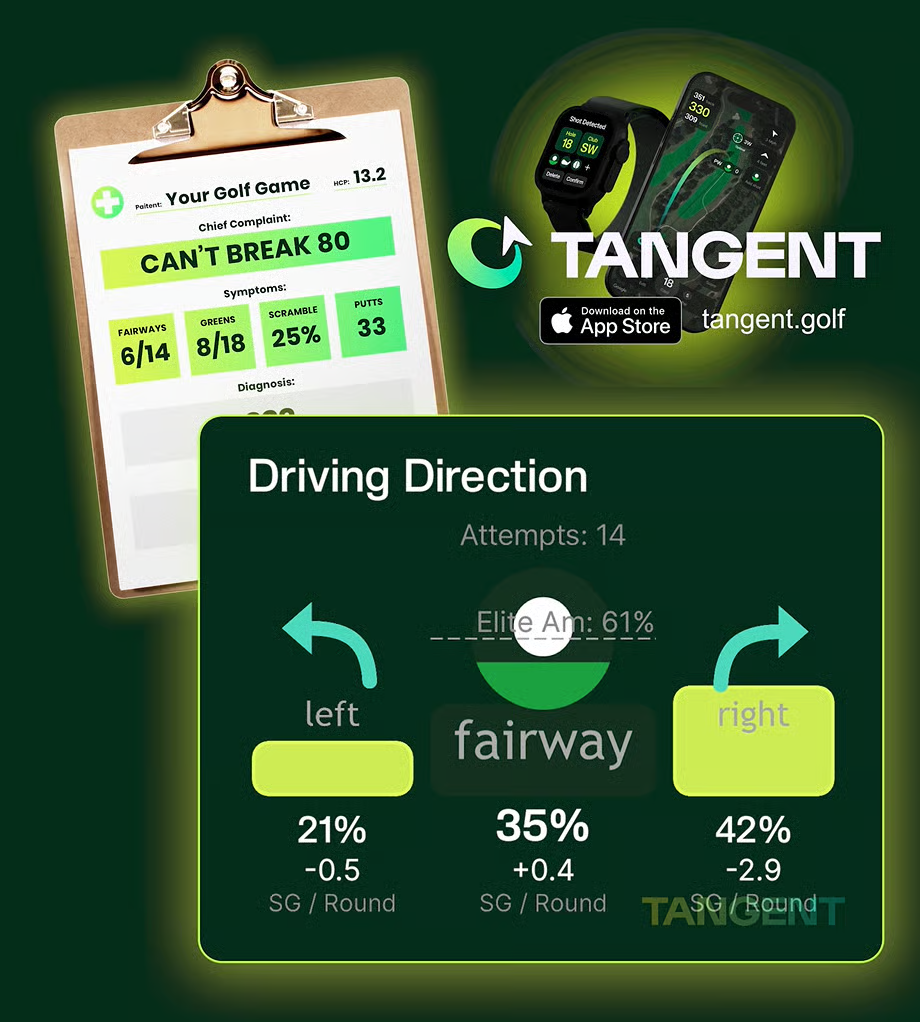
Keep digging and we find it: almost every miss was to the right, two became penalties, and the average drive was 15 yards shorter than the target handicap.
That's a real diagnosis. This golfer doesn't need to "hit more fairways." They miss to one side, pay a huge price when they do, and could use more length.
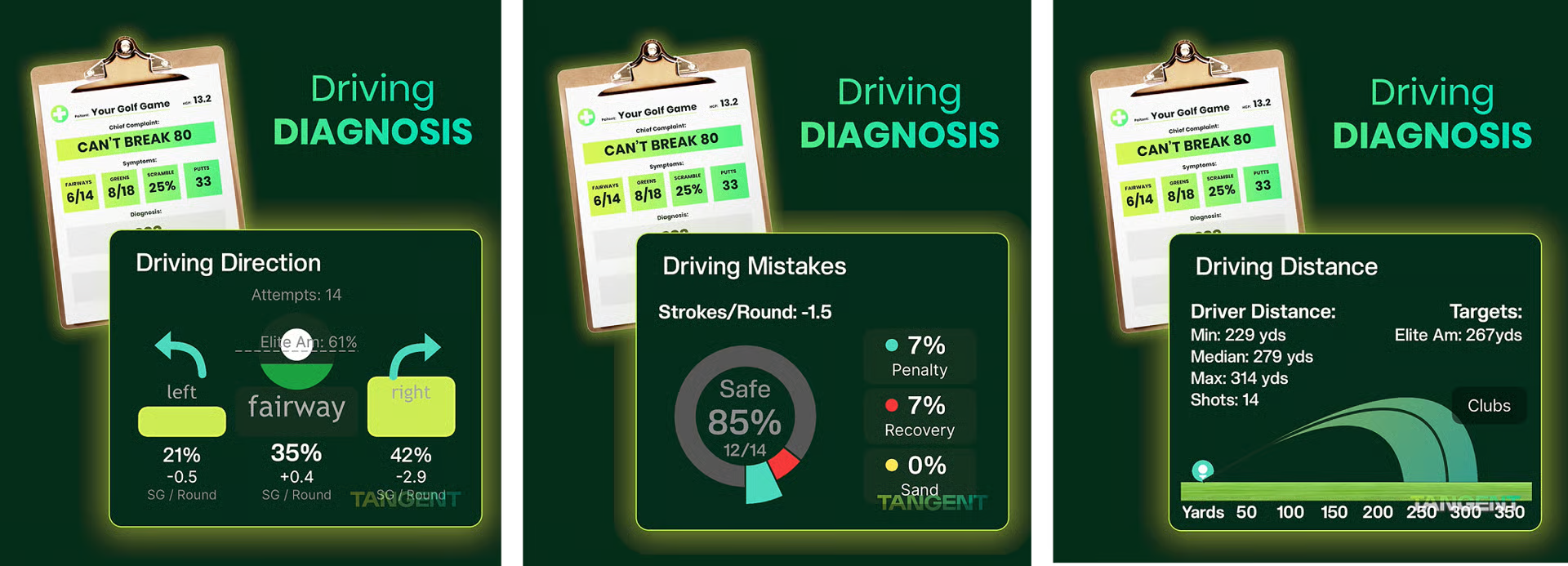
Prescription: speed and strike quality for the distance, target selection for the penalties.
Complaint 2: I'm Not Hitting Greens
This one's different, because greens in regulation is genuinely a good statistic. Hit more greens and you'll almost certainly shoot lower scores.
But it's still not a diagnosis.
Our patient hit eight greens. There are at least four completely different causes behind that same number:
- You drove it left behind trees all day and your approach game never had a chance. That's a driving problem.
- You had clean looks and hit terrible iron shots. That's an approach problem.
- Your shots were fine, but you were firing at tucked pins you had no business aiming at. That's a strategy problem.
- You drove it well and struck it solidly, but had hybrids and long irons into every green because you don't hit it far enough or you're playing the wrong tees. That's a distance problem.
Eight greens. Four diagnoses.
In medicine this is a differential diagnosis. A patient walks in with chest pain — heart, lungs, or a pulled muscle? The symptom is real, but you don't treat it until you know the cause.
So we have to ask where you missed. Missing everything short is a completely different disease than missing everything left.
Short and long point to distance control — strike quality, low point control, or the one we see most: choosing clubs off your best shot instead of your average one. Most amateurs don't miss because they can't hit a 7-iron 165. They miss because they pick the 165 club and hit it 154.
Missing left is a different animal entirely: face control, path, start direction.
Our patient's chart reads: missing greens, mostly short, primarily from 140 to 170 yards, very little left-to-right dispersion.
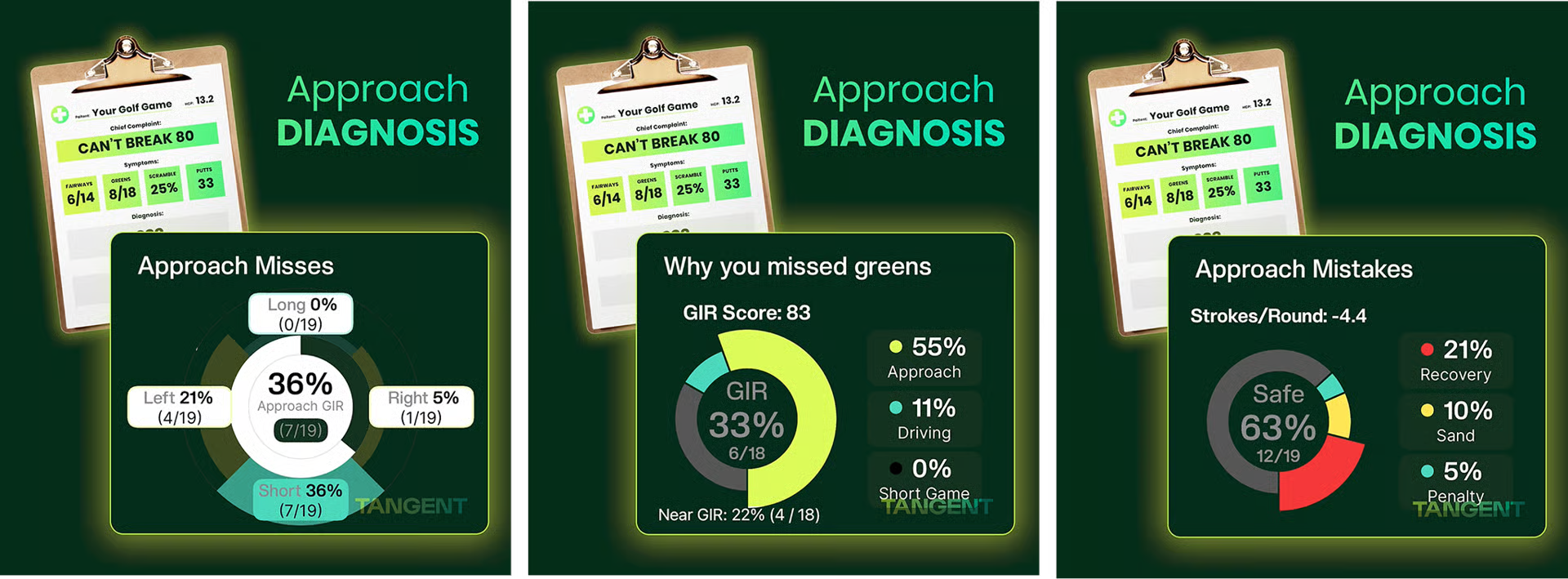
That doesn't say rebuild your swing. It says club selection, distance control, and strike quality. All of it was hiding inside "eight greens."
Complaint 3: My Short Game Is Killing Me
This might be the most misdiagnosed problem in golf.
Twenty-five percent scrambling. Ugly. So naturally you head to the chipping green.
That makes sense until you look at what scrambling actually measures. To save par you have to hit a good chip and make the putt. Those are two completely different skills, and scrambling rolls them into one number.
Imagine chipping four balls to four feet. Fantastic day. Then you miss three of those putts. Your scrambling is an awful 25%, so tomorrow you go practice chipping — and you've just treated the wrong problem.
Flip it. Chunk a chip to 15 feet and drain the putt. Congratulations, the stat says you're a short game wizard. You just had a hot putter.
Imagine your doctor calling with blood work: "Good news, we've narrowed it to your kidney or your liver." Nobody would accept that. Golf has somehow convinced us it's normal.
It gets worse, because scrambling ignores difficulty entirely. A bump and run from the fringe counts the same as a plugged bunker lie.
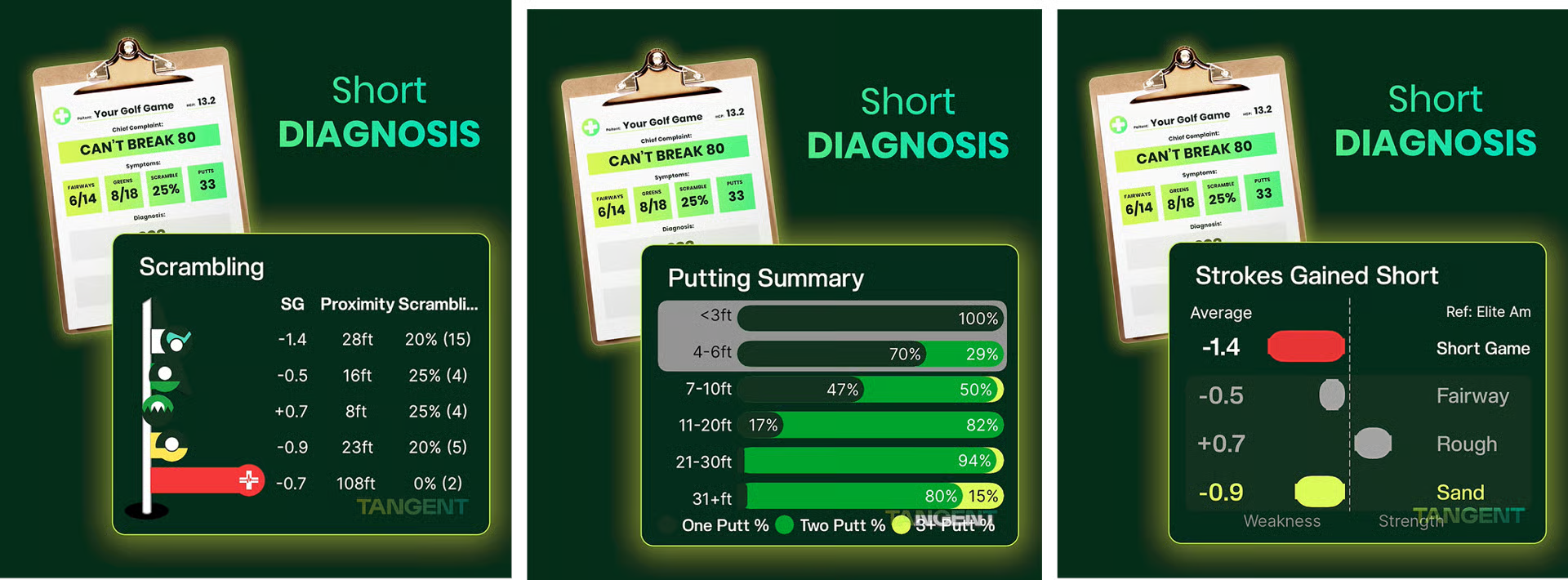
So run real tests. Separate short game from putting, then look at results by lie — maybe you're much better from rough than sand. The golf equivalent of "it hurts when I do this."
Golfers also dramatically overestimate how much scrambling matters in the first place. Before you spend your winter trying to become Phil Mickelson, it's worth knowing what the tour data actually says about short game.
Our patient's real diagnosis: excellent chips, poor conversion inside six feet, weak bunker play. Now there's something to treat.
Complaint 4: I Take Too Many Putts
Golfers have been blaming their putting for decades when putting often isn't the problem.
Start with the obvious flaw. A two-putt from three feet and a two-putt from 50 feet count identically, but one is a disaster and the other is world class.
Here's the part that changed how I think about it though. Total putts is secretly a ball striking statistic.
Think about when your putt total is really low. Usually it's when you missed a lot of greens — you chipped it close and tapped in. Twenty-six putts sounds incredible until I mention you only hit six greens.
Flip it. Hit 16 greens and most of your first putts are from 20, 30, even 40 feet. Lag every one to a tap-in and you've got 32 putts. Sounds average. It was excellent.
The better you strike your irons, the more long putts you face — which means great ball striking can make your putting stats look worse.
There's a medical term for this: referred pain. Your shoulder hurts, so you treat your shoulder, and the real problem was your gallbladder. The number shows up on the green, but the cause was often 150 yards away.
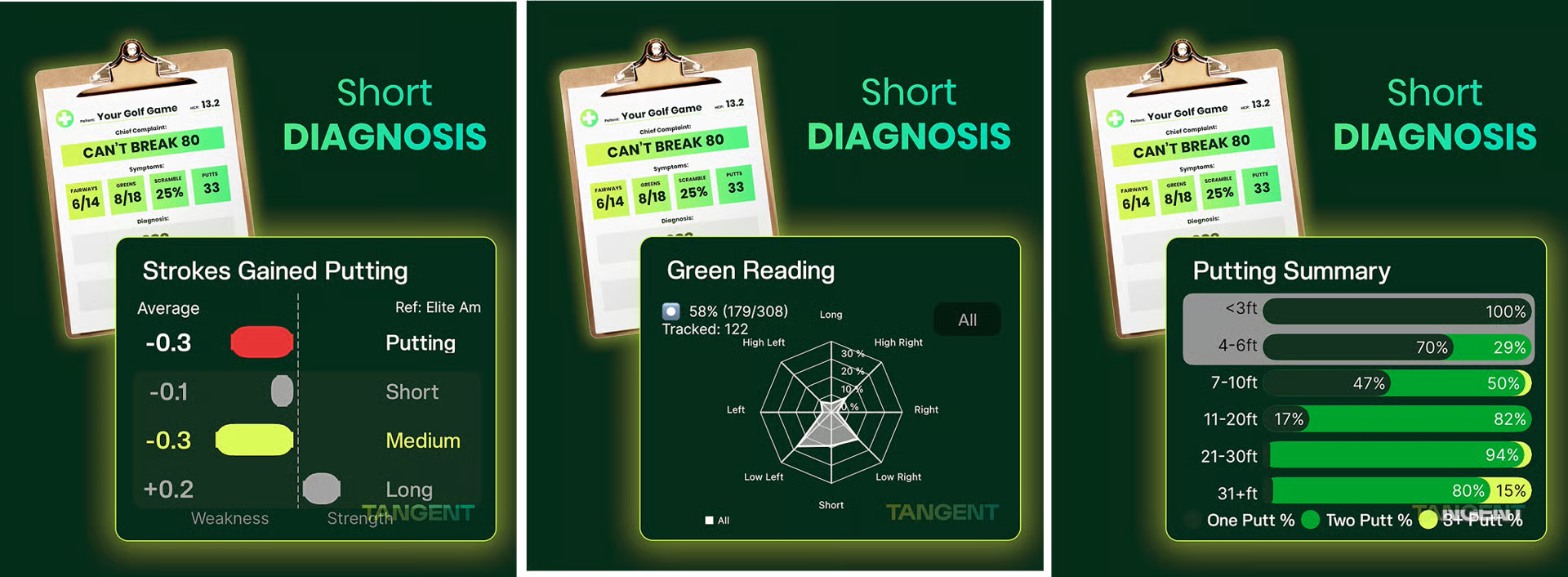
So order one last test. Not how many putts, but from how far:
- Losing strokes inside 6 feet? Probably start line.
- Misses from 10 to 20 feet? Probably green reading.
- Three-putting from 40 feet? That's speed control.
Three diagnoses, three prescriptions. We go deeper on that framework in our putting article.
Our patient: excellent lag putting, weak conversion from 8 to 15 feet. Not "practice putting" — we can tell them exactly what to practice.
The Three Layers
Every traditional golf statistic failed for the same reason. Not because it was wrong, but because it stopped one question too early.
Symptoms. Seven fairways, nine greens, 33 putts. Every doctor wants to hear your symptoms. They just don't stop there.
Severity. Did those missed fairways actually cost you, or did you get away with it? This is where strokes gained changed golf forever — it measured impact, not just occurrence.
Diagnosis. Why did you lose those strokes? Were you aiming right? Taking penalties? Giving away distance? Completely different causes, completely different treatments.
That last layer is the one almost every golfer is missing. Knowing you lost two strokes driving still doesn't tell you what to do on Tuesday. It tells you where to look, not what to fix.
I Didn't Need a Better Scorecard. I Needed a Better Doctor.
That's why I built Tangent — not to replace traditional stats or strokes gained, but to answer the question that always comes next. Why?
It tracks your shots automatically while you play, taking your vitals in the background. It measures impact with strokes gained, then tells you why those strokes disappeared: misdirection, distance control, penalties, recovery shots, target selection.
That's the diagnosis. Then comes the prescription — not generic tips, but a practice plan built around your game. Because two golfers shooting 82 rarely need the same medicine.
Download Tangent Golf and give your game a proper checkup.
One Rule to Take With You
If a statistic can't change what you do on the range on Tuesday, it isn't a statistic. It's trivia.
Fairways, greens, scrambling, and putts are all useful. They're just the beginning of a conversation.
The goal was never to collect more symptoms. It's to understand what's actually making your golf game sick.
That's the difference between describing your round and diagnosing your game. And once you have the right diagnosis, improvement stops feeling like trial and error and starts feeling predictable.
Frequently Asked Questions
Why isn't fairway percentage a useful stat?
Because it treats every miss identically. A ball a yard into the first cut, a ball behind a tree, and a ball in the water all count the same. It also ignores distance, so laying back with a hybrid can improve your fairway percentage while making your scores worse.
Why can't I diagnose my game from greens in regulation?
Greens in regulation is a genuinely good stat, but the same number can have at least four different causes: bad driving that left you no chance, poor iron play, aggressive target selection, or simply having long clubs into every green. Each requires a completely different fix, so you need to know where and why you missed.
Is scrambling percentage misleading?
Yes, in two ways. It combines chipping and putting into a single number even though they're separate skills, and it ignores shot difficulty entirely — a bump and run from the fringe counts the same as a plugged bunker lie. Separate the two skills and look at results by lie instead.