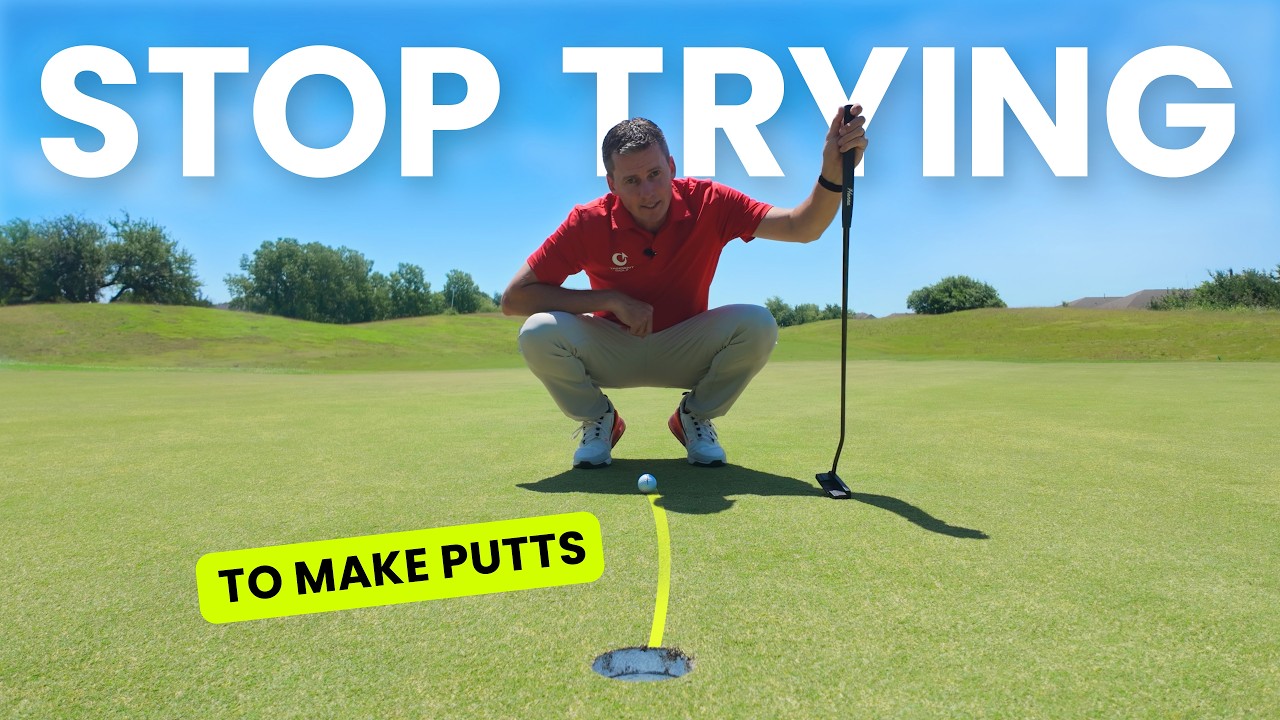
If you want to putt better, you need to stop trying to make putts.
I know how that sounds. Hear me out.
Play 18 holes and you're going to make exactly 18 putts. One per hole, every round, forever. That number never changes.
So putting was never about making more. It's about missing less — and missing in ways that don't cost you.
Here are three putts that explain the whole thing.
Watch the Full Breakdown
Watch the full video on YouTube
Dallas walks through the capture-size demo and the dispersion experiment on the green. Everything below is the written version.
Three Feet, Eight Feet, Thirty Feet
From three feet, you're basically automatic. Not 100%, but if you miss this one it really hurts. The average score from here is one stroke.
From eight feet, it's already a coin flip. Five feet further back and you've gone from automatic to 50/50. Even the best players in the world average a stroke and a half from eight feet.
Now here's the part that should rewire how you think.
How far back do you have to go to lose the next half stroke? Thirty feet.
Read that again. You lose the first half stroke moving from three feet to eight. Losing the next half stroke takes another twenty-two feet.
Which means the difference between a 15-footer and a 25-footer is almost nothing.
And the difference between an 8-footer and a 3-footer is everything.
Putting is not linear. Once you understand that, you stop treating every putt the same way — and that single change is what stops three-putts.
Why Putts Per Round Is Lying to You
Let's start with the stat most golfers use to judge their putting. Thirty-two putts. Thirty-four. Twenty-nine.
Simple, right?
Not really. Putts per round has no context.
Picture two holes.
On the first, you hit the green and face a 50-footer. You lag it to two feet and tap in. That was an outstanding putt and an easy par.
On the second, you miss the green, hit an elementary chip to three feet… and miss it.
Same two putts. Completely different quality of putting.
That's why the count doesn't correlate with putting ability. What it's actually measuring is your ball striking, your chipping, and everything that happened before you ever pulled the putter. Leave yourself 40-footers all day and two-putt them and that's a great result. Miss a three-footer and that's a poor one.
Both go in the book as two putts.
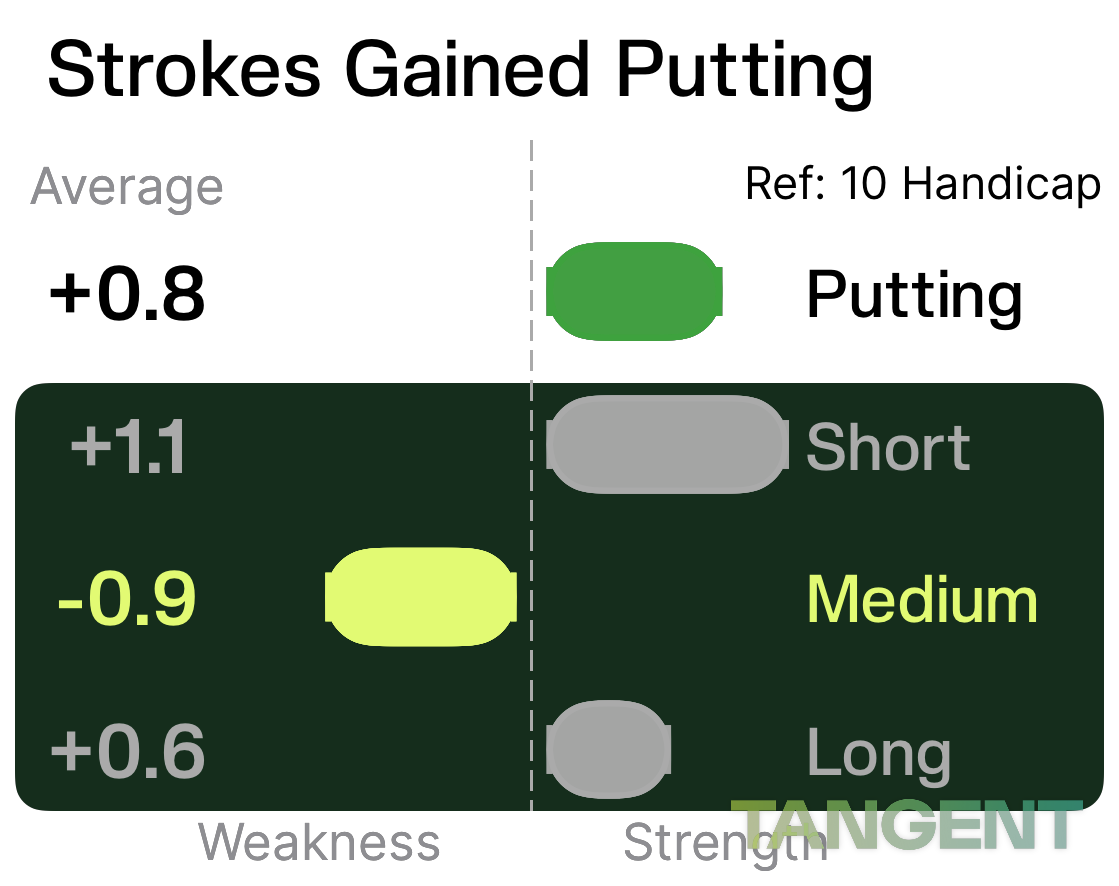
This is where strokes gained is a far better measure — it tells you what a golfer would do on average from any given position, so a two-putt from 50 feet and a two-putt from three feet stop looking identical.
But strokes gained still isn't enough on its own. It tells you whether you gained or lost strokes. It doesn't tell you why.
And the why is the only thing you can actually practice.
Speed, Line, Read — In That Order
Every putt comes down to three things, and the order matters enormously.
- Speed. Did you hit it the pace you intended?
- Line. Did you start it where you intended?
- Read. Did you play the right amount of break?
Most golfers would flip that list upside down. Read feels like the hard part, so it feels like the important part.
It isn't that read doesn't matter. It's that read is the most complicated of the three and gets influenced by slope, grain, and even wind. More importantly, these skills are interdependent — and speed sits underneath both of the others.
Think about what happens when the speed is wrong.
You hit a putt too soft and it misses low. Was that a bad read? You have no idea — you didn't hit it hard enough to hold the line.
You pull a putt off your intended line and it goes in. Was that a good read? Again, no idea. You never started it where you meant to.
Speed and line determine whether the feedback on your read is even useful.
That's why the order is fixed. Not because read is unimportant, but because you can't evaluate it until the first two are clean.

You're Almost Certainly Hitting Putts Too Hard
Here's the trap.
You're counting putts, so you feel like you have to make everything. Which means you have to get it there. Which means you run it well past — because leaving it short feels awful. Short feels like you never gave it a chance.
But there's a physical cost to that speed, and it's bigger than most golfers realize.
The hole is 4.25 inches wide. That's only true if the ball is dying into it. The faster the ball is travelling, the less of the hole it can actually use — what's called effective capture size:
- Perfect pace, dying in — the full 4.25 inches
- 1 foot past — 2.6 inches
- 2 feet past — 1.9 inches, more than half the hole gone
- 3 feet past — 1.4 inches, about a third of the original
- 4 feet past — under an inch
At four feet past, you essentially have to hit dead center to have any chance.
So yes — a putt left short has a 0% chance of going in. But a putt racing four feet past has almost 0% chance too. You didn't buy yourself a look. You bought yourself a four-footer coming back, and even a tour pro misses that one 10% of the time.
The Dispersion Problem
Here's the proof, and it's the part that convinced me.
Forget the hole for a second. Imagine hitting seven putts from 10 feet, focused purely on speed, trying to stop them all on a single dot. You'd end up with a cluster maybe two feet deep. Pretty good.
Now say your goal was making sure every one of those putts reached the hole. You'd effectively shift the target back so your shortest putt still gets there. Your longest is now about two feet past.
From 10 feet, that's fine. Every comebacker is manageable.
Now run the same experiment from 30 feet.
The gap between your shortest putt and your longest is no longer two feet. It's closer to six.
So if you insist on getting every putt to the hole from 30 feet, the tail end of that distribution is six feet past. You're going to miss 30% of six-footers coming back. You've manufactured your own three-putts.
Center the distribution on the hole instead and the picture changes completely. A few finish two to three feet short — never had a chance, but they're easy tap-ins. A few arrive with great pace and a full capture size. One runs three and a half feet past.
You've given yourself real chances at one-putts, a floor of two putts on almost everything, and very few dangerous comebackers.
That's the trade. And outside a certain distance, it isn't close.
The 10% Rule: When to Roll It to the Hole
So where's the line between the two approaches?
It depends on your skill level, but here's the benchmark: the best players in the world control their speed to within about 10% of the length of the putt.
Take a 20-footer. Ten percent is two feet, so your putts are going to finish somewhere in a four-foot band — anywhere from two feet short of the hole to two feet past it.
That band is fixed. Your speed control is what it is. The only thing you get to choose is where you point it.
Option one: aim to finish at the hole. The band sits centered on the cup. Your worst miss leaves a two-footer coming back, and roughly half your putts still finish past the hole with a real chance to drop.
Option two: make sure every putt reaches the hole. Now you have to shove that entire band forward, far enough that even your shortest putt gets there. Your shortest now finishes right at the hole — and your longest finishes four feet past.
Identical putt. Identical speed control. But you've swapped a two-foot comebacker for a four-footer, and the difference in make rate between those two is enormous.
That is a bad trade, and you're making it several times a round.
So here's the working rule:
- Inside roughly 10 to 15 feet — go ahead and roll everything to the hole. Your comebackers stay manageable.
- Outside roughly 15 feet — you should be missing a meaningful percentage of putts short. That's not timidity. That's optimization.
You're going to make 18 putts either way. The goal is to miss less.
Diagnose Every Putt in Three Questions
Tell me if this sounds familiar. You finish a putting session, and if I asked how many you made, you could tell me. If I asked what happened when you missed, you'd stumble.
That's the gap. Here's how to close it.
After every putt, ask three questions in order.
1. Did I hit it my intended speed?
If you wanted it to finish near the hole and it stopped three feet short — that's a speed miss. Same if it ran four feet by. Your speed didn't match your intention.
And because speed and read are linked, you can stop right there. No further diagnosis is possible or useful.
2. Did I start it on my intended line?
Speed was good? Then ask where it started. You meant to start it right of the cup and it started left — that's a line miss.
Not a bad read. Not bad luck. Line.
3. Did I choose the right read?
Speed was good and it started where you wanted? Now the read is fair game.
Missed low means you underread it. Missed high means you overread it.
That's the entire framework. Three questions, and every miss you make gets a name.
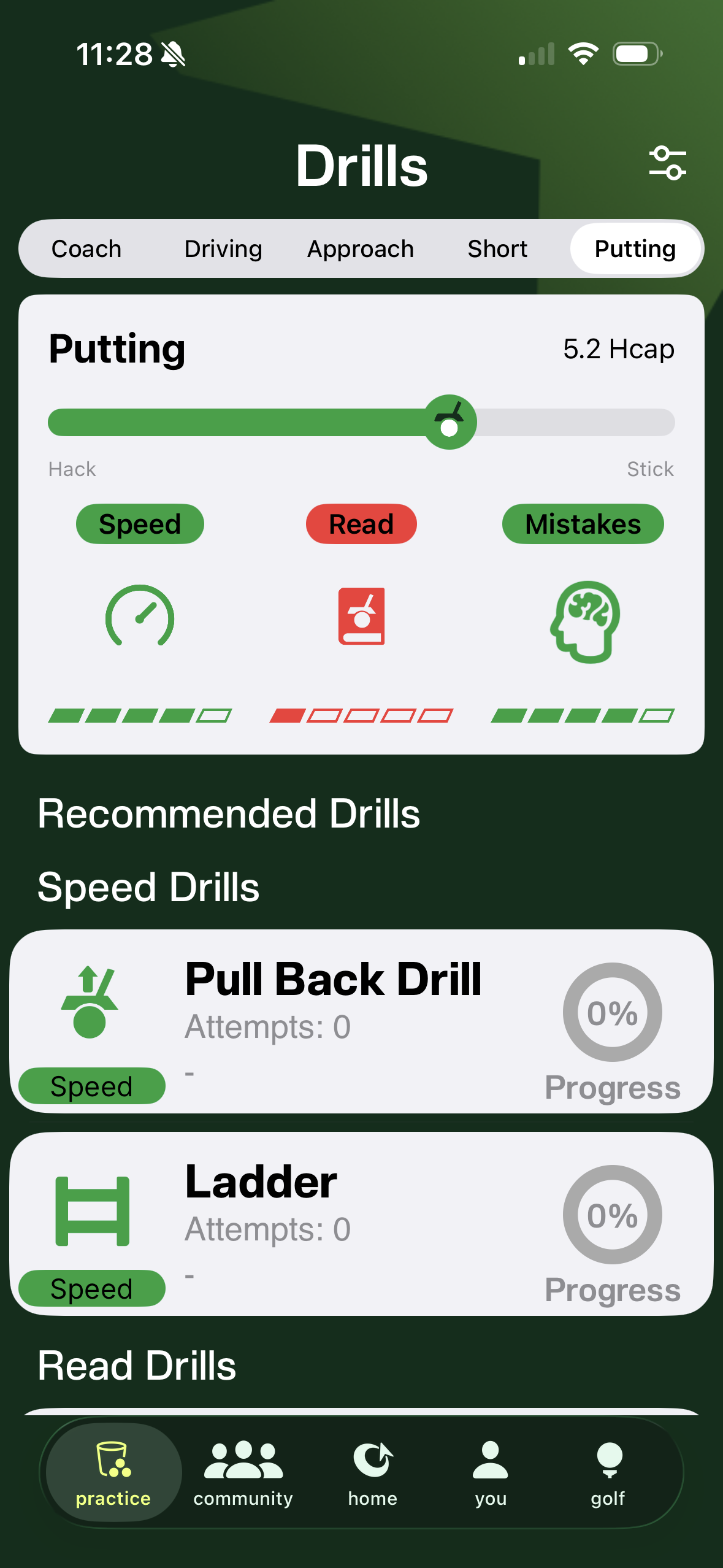
This is exactly why we built putt tracking into Tangent. During a round or an integrated putting drill, a single tap on your phone or watch logs whether it was speed, line, or read. Tangent aggregates it into a radar chart so the trend becomes obvious.
Your putting almost certainly has a tendency you've never noticed. I know I tend to miss short and low, so I practice speed and adjust my reads accordingly.
Without feedback, practice is just a guess.
One More Thing That Should Take the Pressure Off
Good putts miss all the time. Especially outside eight or ten feet.
A perfectly rolled 12-footer can miss. A perfectly read putt can catch a tiny bump, an old ball mark, a spike mark. A green can behave differently than it did twenty minutes ago simply because it's drier.
Putting is not a video game. The surface is imperfect.
You can see this for yourself with a stimpmeter or even a small ramp. Roll seven balls from the same spot, same starting direction, same speed, same part of the green. They finish about seven inches apart front to back, and spread ten inches to a foot side to side.
Identical inputs. Different outcomes. Every time.
So your job was never to make every putt. Your job is to hit the speed you intended, on the line you intended, with the best read you can give it — and then accept the result.
That isn't lowering your standards. That's what putting actually is.
Practice the Diagnosis, Not the Vibes
Once you know whether your miss is speed, line, or read, you stop going to the putting green and blindly hitting balls. You practice your weakness.
If speed is the problem, you need distance control work. The ladder drill is the classic — and notice the goal isn't to make anything. It's to finish inside the gates at the right distance.
If line is the problem, you need start line work. A straight putt drill, or gates and coins to confirm you're actually launching the ball where you're aiming.
If read is the problem, you need green reading work. The circle drill is excellent here because it forces uphill, downhill, and sidehill putts from every angle, so you're reading every kind of break.
That's the whole point. The drill should match the diagnosis. Tangent makes it easy to pair a drill with the exact skill you need to develop, so practice stops being random.
Not vibes. Based on what's actually costing you strokes.
Stop Counting Putts
Back to where we started. Three feet, eight feet, thirty feet.
The reason those three numbers matter is that putting isn't linear. And when you treat every putt with the same goal — make it — you introduce the exact mistakes that produce three-putts.
So stop counting putts as if the number tells the story. Start asking better questions.
Did I hit it the right speed? Did I start it on line? How was my read?
Diagnose every putt and you'll finally have the information you need to practice properly.
The goal isn't to make every putt. The goal is to miss so well that the next one is easy.
Because we don't get mad at easy pars.
Tools to Improve Faster
We built Tangent around diagnosis and measurement, because "I missed" is just not enough information.
Tangent shows you exactly which of those three domains is costing you strokes, then gives you the drills and the measurement to actually fix it every time you step on the putting green.
Download Tangent Golf and let's improve your putting.
Frequently Asked Questions
Why is putts per round a bad stat?
Because it has no context. A two-putt from 50 feet and a two-putt from three feet count identically, even though one is excellent putting and the other is poor. Putts per round mostly measures the quality of your ball striking and chipping — how close you got before you ever pulled the putter.
Is it really okay to leave putts short?
Outside about 15 feet, yes. A putt that races four feet past has almost the same chance of going in as one left short, because the effective capture size of the hole shrinks to under an inch at that speed. Worse, it leaves you a four-footer coming back. Centering your distribution on the hole produces fewer three-putts overall.
What is effective capture size?
It's how much of the hole a ball can actually use at a given speed. A ball dying into the cup gets the full 4.25 inches. One foot past drops it to 2.6 inches, two feet past to 1.9 inches, three feet past to 1.4 inches, and four feet past to under an inch.
How good should my distance control be?
The best players in the world control speed to within roughly 10% of the starting distance. From 20 feet that means plus or minus two feet; from 30 feet, plus or minus three. It's a useful benchmark for judging whether your speed is genuinely the problem.
Should I work on speed, line, or read first?
Speed, then line, then read — always in that order. Not because read doesn't matter, but because bad speed or a bad start line makes it impossible to tell whether your read was any good. You can't get useful feedback on break from a putt you hit too soft.
How do I know what to practice on the putting green?
Diagnose your misses first. After each putt, ask whether the speed matched your intention, whether it started on your intended line, and whether you read the break correctly. Then pick the drill that matches the answer: ladder drills for speed, gate or straight-putt drills for line, and circle drills for read.
Why do good putts still miss?
Because putting surfaces are imperfect. Roll seven balls with identical speed and direction from the same spot and they'll finish about seven inches apart front to back and up to a foot apart side to side. Bumps, old ball marks, spike marks, and changing moisture all move the ball. Accepting this isn't lowering your standards — it's an accurate picture of the game.