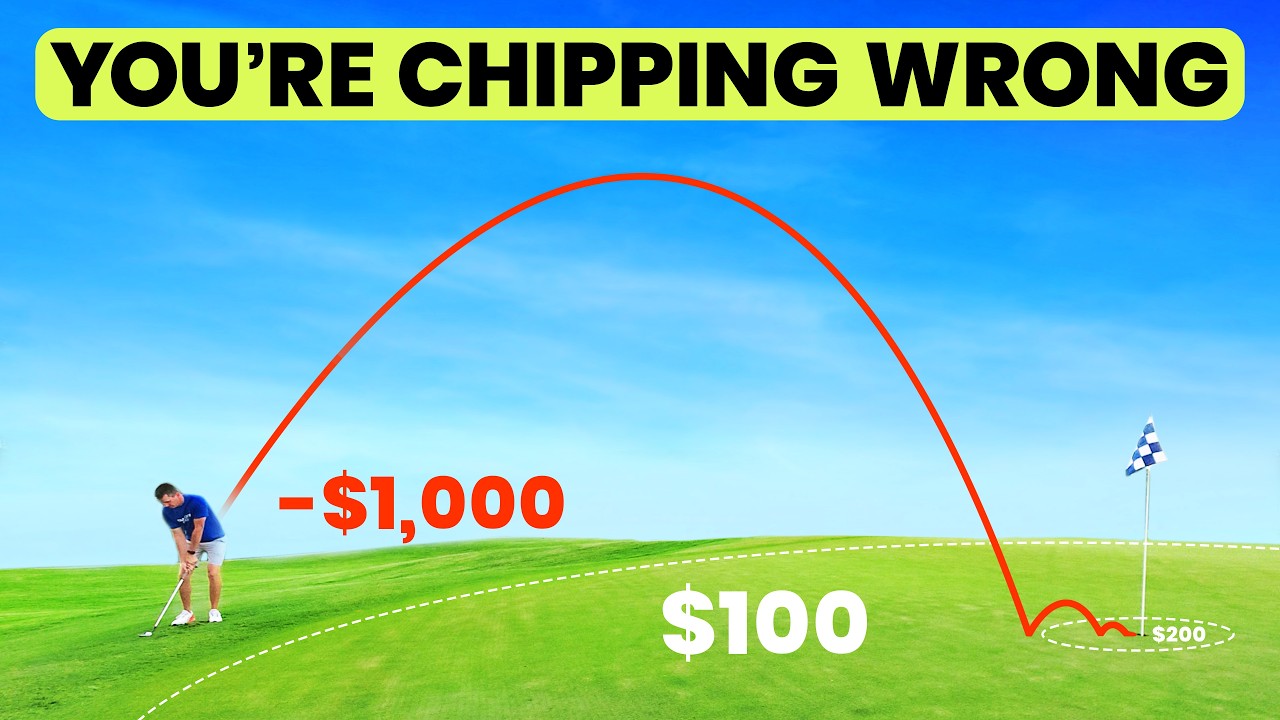
Before you hit your next chip, imagine a bet.
I'll give you $100 if you get the ball anywhere on the green. I'll give you another $100 if you get it inside three feet.
But here's the catch. If you miss the green and have to chip again, you owe me $1,000.
Are you still hitting the same shot you were about to hit?
Of course you want it close — the closer you are, the better your chance of saving par. But you can't chase $100 when it risks $1,000. That's exactly how bogeys turn into doubles, and it's what most golfers get wrong around the greens.
They're not choosing the shot with the best average outcome. They're choosing the shot with the highlight reel outcome.
Watch the Full Breakdown
Watch the full video on YouTube
Dallas walks through the bet, the ladder, and the PGA Tour data on course. Everything below is the written version.
First, an Uncomfortable Truth
Everyone says short game is the fastest way to save strokes. That's partially true.
If you're missing a lot of greens, short game matters. If you can't get out of bunkers, short game matters. If you're constantly two-chipping, short game absolutely matters.
But the ceiling on short game is much lower than golfers think.
Start here: even PGA Tour pros only get up and down about 60% of the time. When the best players on earth miss a green, they're still making bogey roughly four times out of ten.
And remember, their misses are better than yours. They're rarely short-sided and buried. Most of the time they've got a decent amount of green to work with, a reasonable lie, and world-class technique — and they still don't get up and down consistently.
The data that should change your practice
I pulled the top 20 scorers on the PGA Tour this season — the 20 best players on the planet right now — and looked at where each ranks by skill category.
Approach play:
- 80% of them rank inside the top 50
- 30% rank inside the top 10
- Only 20% rank worse than 50th
Short game:
- 50% of them rank 50th or worse
- Only 10% rank inside the top 10
Sit with that. The top 20 scorers are almost all elite approach players, but half of them are merely okay around the greens.
Short game is the weakest predictor of score of all four categories.
The best players in the world get the simple ones up and down. The tough ones, they get on the green and guarantee themselves a putt.
So if you're a 10 handicap spending 40% of your practice time on short game hoping to scramble like a pro, the math just doesn't support it. We get misled because that's what pros say in interviews — but they say it because they already have elite ball striking.
The best way to improve your short game is to miss fewer greens.
Back to the Bet
None of this is an argument for defeatist golf where you dump everything at the middle of the green. That's not great either, and it's not the point.
The point is risk management. Get it as close as you can — just not at the expense of bringing a two-chip into play.
Here's a working rule: if you can't realistically get the ball on the green 95% of the time, you're probably hitting the wrong shot.
Why so strict? Because we covered this in the putting article — the hole is small. You need to be inside a three-foot circle to have a genuinely good chance of getting up and down. Hit it to eight feet and your odds are already under 50%. Outside that, realistically you're looking at three shots to hole out.
That's not meant to demotivate you. It's meant to make you realistic.
The two-chip is the killer. When you hit it close, you save fractions of a stroke. When you blade it, chunk it, or need a second chip, you throw away a full shot or more.
Those two things are not the same size, and golfers treat them like they are.
Variance Is the Real Short Game Skill
Every short game shot has a range of outcomes — a best case, an average case, and a worst case.
The goal is to minimize the gap between the best case and the worst case. That gap is variance.
Take an extreme example. You're just off the green in the fringe.
You could putt it. Hit that putt a hundred times and some finish close, most finish average, a few run long or short. But the worst one is still on the green. That's a low variance shot.
Or you could hit the super flop. The one that turns heads. Pull it off and it looks incredible. Your best outcome might be inside three feet.
But your worst outcome is skulled into somebody's backyard. That one costs you $1,000.
Here's how golfers fool themselves: when choosing a shot, they picture the best possible outcome and never ask what happens if they don't quite execute.
That question is short game. Not just "what happens if I hit this well," but "what happens if I don't — and how do I shrink the range?"
Notice that the putt and the flop have the same ceiling. Both could go in. But the putt has a dramatically better floor.
So choose the shot that still gives you a decent outcome when your execution isn't perfect. That's a dispersion skill, not a technique skill.
The Ladder: Four Shots, In Order
There are really only four types of short game shot, and the order matters:
- Putt
- Bump and run
- Standard pitch
- Lob or flop
Think of it as a ladder running from lowest risk to highest. Lowest loft, lowest speed, lowest variance at the bottom.
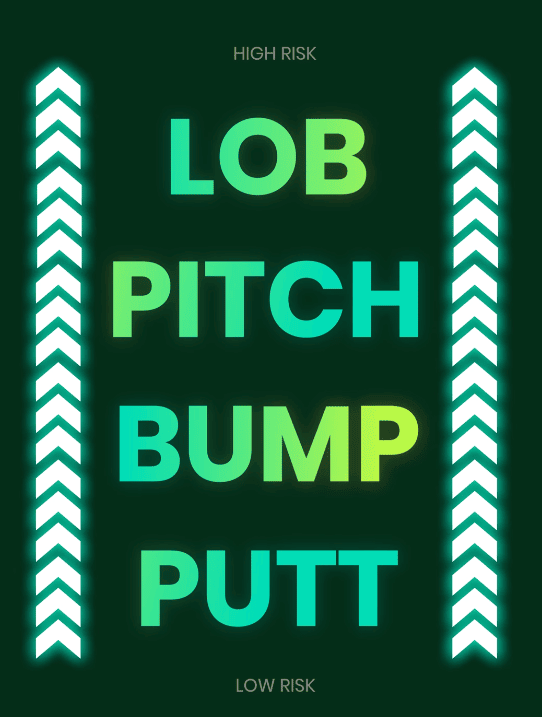
Most golfers climb it backwards. They reach for the 60° wedge by default and then wonder why their results are so inconsistent.
Flip it. Start at the bottom rung and only climb when the shot below genuinely can't do the job.
Your goal around the green is to get in the hole in two shots or fewer — while guaranteeing it takes no more than three.
Three Questions Before Every Short Game Shot
1. What shot wins the first $100?
What's the lowest rung on the ladder that guarantees this ball finishes on the green? Maybe that's the putter. Maybe a bump and run. Maybe a simple pitch.
Start there.
2. Can I get it closer without risking the $1,000?
This is the important one. You want that bonus $100 for getting inside three feet — but not at any price.
If putting leaves you 10 feet but a bump and run gets you closer while still guaranteeing the ball finishes on the green, hit the bump and run. Go win the extra $100. If a pitch could get closer still and the bad version also finishes on the green, hit the pitch.
Be aggressive when the downside is protected.
But if the shot that might finish inside three feet also brings a chunk, a blade, the bunker, or a missed green into play — that's a bad bet. You're risking $1,000 to win $100. Stop climbing.
3. If you can't safely get close, where's the smart target?
Sometimes the pin isn't your target. Sometimes the pin is bait.
If the only route to close brings the $1,000 into play, move the target. Aim at the fat part of the green, even if that's 15 feet away. Aim where the bad version still leaves you a putt.
That's not scared golf. That's scorecard golf.
We're not trying to hit more great shots. We're trying to hit fewer bad ones.
Why Less Loft Works
The logic is simple and it compounds:
Less loft means a shorter swing. A shorter swing means less speed. Less speed means smaller mistakes.
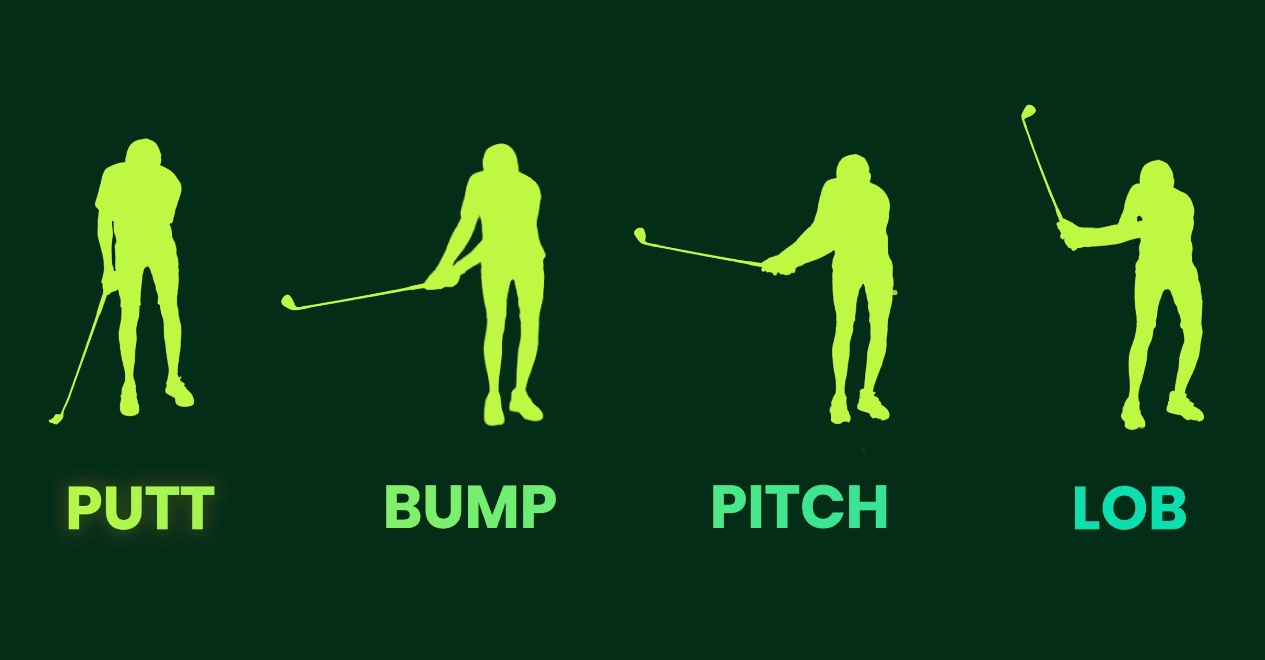
Fewer things can go wrong.
Look at what a bad version of each shot actually costs you:
- A bad putt from the fringe finishes maybe six feet past
- A bad bump and run leaves you 20 feet
- A bad pitch leaves you a longer putt
- A bad flop can go literally anywhere
Honestly, most of us should just delete that top rung. There's rarely a good reason to hit a flop, and the disaster potential is too high. You're probably a decent putter — just get it on the green.
Loft itself isn't bad. But loft is expensive. Use it when it buys you something, not because the pin is tempting.
Let the Danger Set the Target
Here's how to visualize the whole strategy: your target calibrates based on danger.
Low danger — clean lie, plenty of green, no bunker, no short-sided miss. Your target can move closer to the hole. You can use more loft, land it closer, chase more upside. The bad version still finishes on the green with a putt.
High danger — bad lie, short-sided, bunker in front, green running away, no landing area. The target has to move away from the hole. And usually the club changes too: less loft, lower flight, bigger landing area, more room for the ball to release.
The worse the downside, the further your target moves until that $1,000 penalty is off the table.
So the question was never "how do I hit this close?"
It's "what's the closest target that still avoids the $1,000 miss?"
The Lie Sets Your Risk Budget
Keep this simple.
A clean lie gives you more options. The ball's sitting up, so you can predict contact, launch, spin, and rollout. More shots pass the test. You can afford to be aggressive.
A bad lie gives you fewer. Sitting down in the rough, the ball might come out dead or it might jump. The face can twist. You may get no spin at all. The exact shot that was safe from the fairway becomes a bad bet from there.
Better lie, lower variance, more options. Worse lie, higher variance, target moves safer.
Which brings us to bunkers — where the mistake almost all of us make is aiming at the pin.
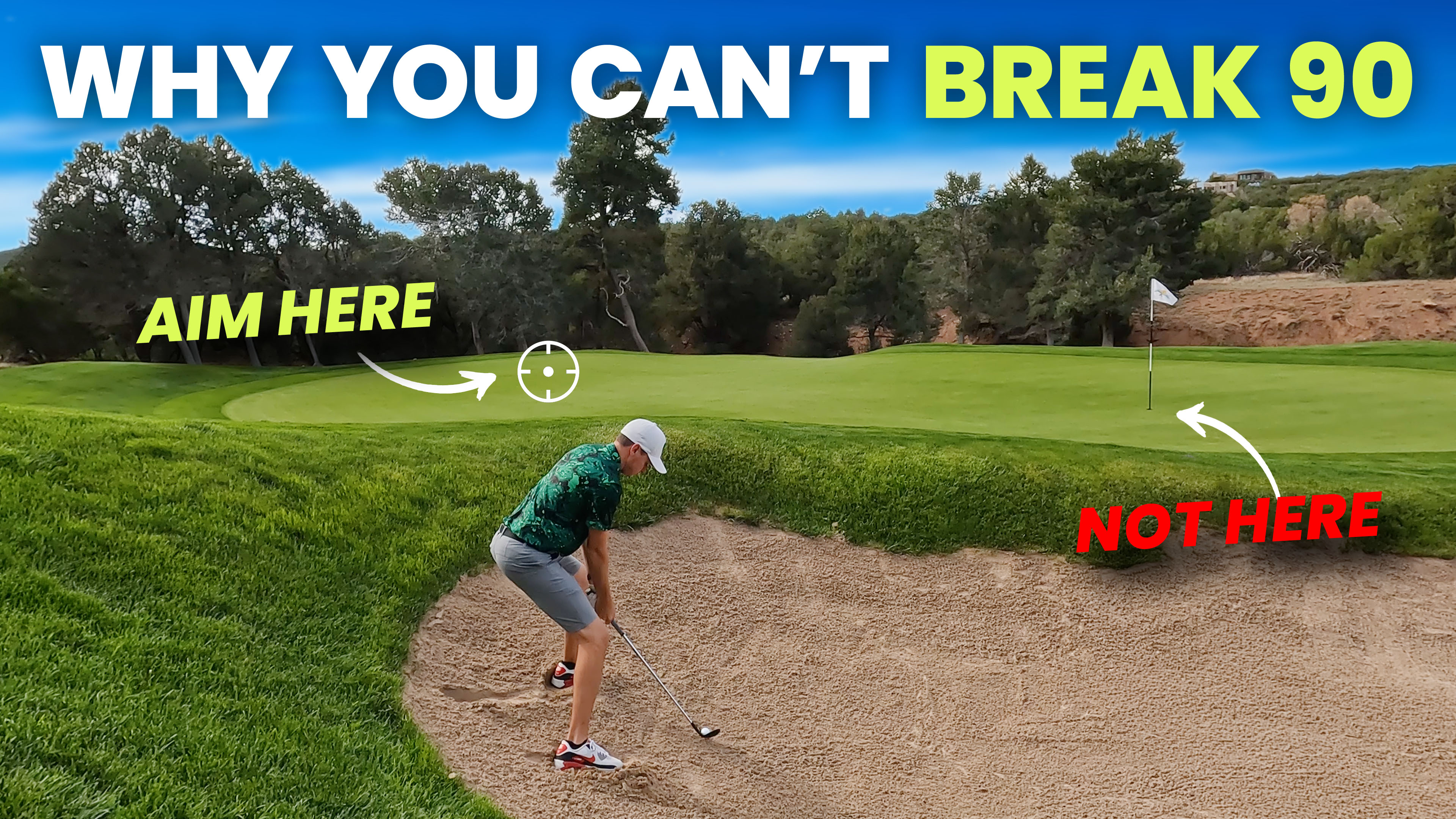
Unless you're spending serious practice time in the sand, and most of us aren't, the $1,000 penalty is everywhere in a bunker. You don't have to aim at the flag. Aim for the fat part of the green and give yourself margin. Get it out, get it on, have a putt for the save.
The pattern across every lie is the same: most golfers let the pin choose the shot. Better players let the lie choose the shot.
And if the lie says the aggressive shot doesn't pass the bet, don't hit it.
This is also why skill matters. The bet is identical for everyone, 10 handicap to tour pro — the $1,000 penalty doesn't shrink, and the next shot still needs to be a putt. What changes is how many shots can pass the test. Pros can use more loft more often because they've practiced enough to reduce the variance.
"My Short Game Was Bad" Isn't a Diagnosis
Most golfers don't actually know what their short game problem is. They just say it was bad today.
Bad how?
- Were your chips on the green but too far away? That's a proximity problem.
- Were you struggling from a specific lie, like bunkers? That's a different problem entirely.
- Were you chipping twice? That's a disaster avoidance problem.
Those three require completely different fixes, and grinding on the wrong one costs you months.
This is what we built Tangent for. With fully automated shot tracking, it can tell the difference between bad short game and bad strategy — whether you should be grinding in the bunker or fixing the approach shot that put you there.
If you see three two-chips in a round, that's not simply bad short game. That's three times the floor collapsed. Three times you paid the $1,000.
And the fix might not be hours of practice. It might be less loft. A different club. A simpler shot. Or better approach targets so you stop short-siding yourself in the first place.
How to Actually Practice Short Game
Don't start with the flop shot. Start by building reliable, low variance options:
- Get genuinely comfortable putting from off the green
- Build one bump and run you trust
- Build one stock pitch
Then practice the situations where the $1,000 keeps showing up — bad lies, bunkers, short-sided shots, awkward stances.
The goal isn't to become Phil Mickelson. The goal is to create more shots that pass the bet.
Come Back to the Bet
$100 on the green. Another $100 inside three feet. But $1,000 if you have to chip again.
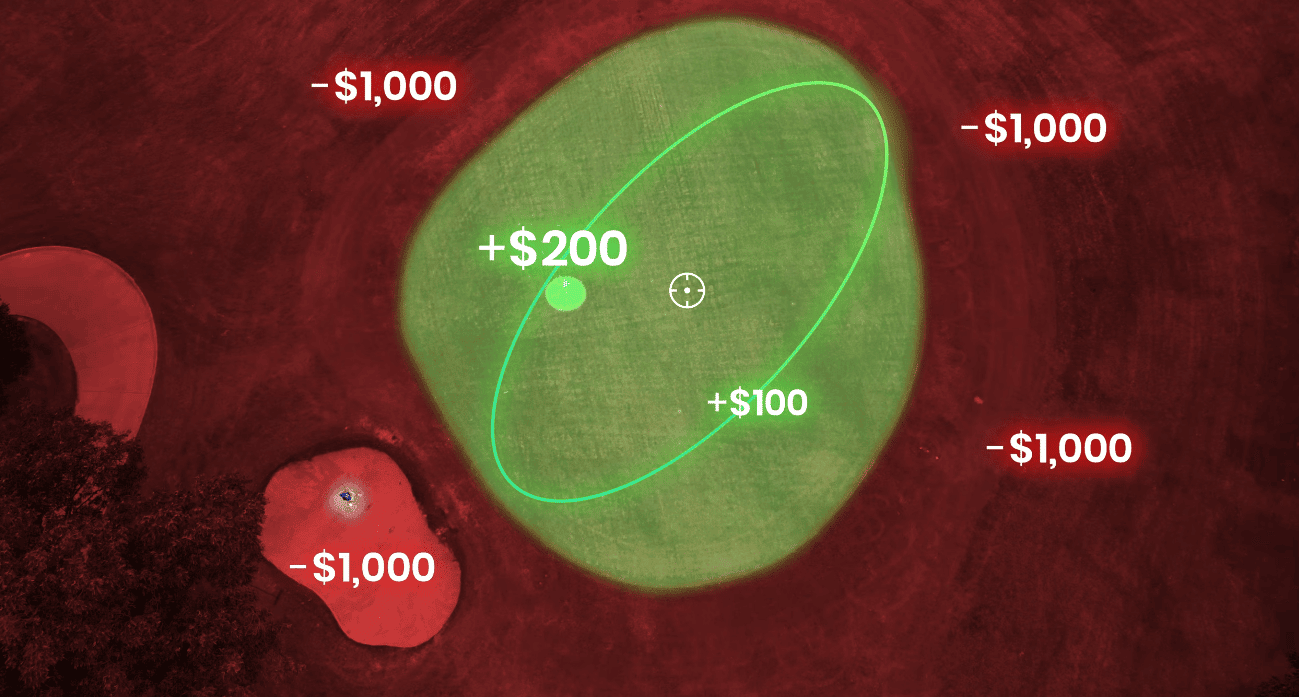
The bet works because it forces you to think about the downside — the entire range of outcomes, not just the one where you execute perfectly.
The ceiling matters. You want it close. But the floor matters more, because a routine bogey turns into a double faster than you think.
Choose the shot that gives you a chance at par but guarantees bogey.
That's short game. That's course management. That's shooting lower scores.
Tools to Improve Faster
If you want to know where your short game is actually leaking strokes — two-chips, bunkers, bad lies, or poor targets — Tangent breaks it down after every round, with integrated drills to measure whether your practice is working.
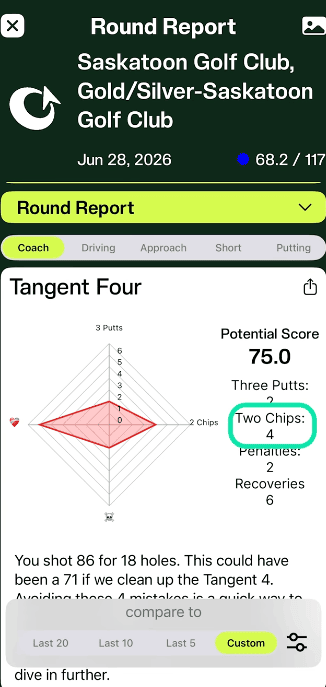
Once you know where the $1,000 mistakes are coming from, you can stop guessing and start fixing the right thing.
Download Tangent Golf and let's improve.
Frequently Asked Questions
Is short game really the fastest way to lower my scores?
Less than you've been told. Short game is the weakest predictor of score of the four skill categories — half the top 20 scorers on the PGA Tour rank 50th or worse in it, while 80% rank inside the top 50 in approach play. Short game matters if you're two-chipping or stuck in bunkers, but the ceiling on improvement is lower than most golfers assume.
How often do tour pros get up and down?
About 60% of the time. Even the best players in the world make bogey roughly four out of ten times when they miss a green — and their misses are typically far better than ours, with a decent lie and plenty of green to work with.
What is a two-chip and why does it matter so much?
A two-chip is needing more than one shot to get the ball onto the green from around it. It matters because the costs are asymmetric: hitting it close saves you a fraction of a stroke, while a two-chip throws away a full shot or more. Avoiding the downside is worth far more than chasing the upside.
Which short game shot should I use?
Work up a ladder from lowest risk to highest: putt, bump and run, standard pitch, then lob or flop. Start at the bottom and only climb when the shot below genuinely can't do the job. Most golfers do the opposite and reach for a lob wedge by default.
How close do I need to hit it to get up and down?
Inside about three feet gives you a good chance. At eight feet your odds are already below 50%, and outside that you're realistically looking at three shots to hole out. That's why guaranteeing the ball finishes on the green matters more than trying to hit it close.
Should I aim at the pin from a bunker?
Usually not. Unless you practice bunkers seriously, the risk is everywhere in the sand. Aim for the fat part of the green, get the ball out in one, and give yourself a putt for the save.
Why does my lie change which shot I should hit?
Because the lie determines how much variance you're dealing with. From a clean lie you can predict contact, launch, spin, and rollout, so more shots are safely available. From a bad lie the ball might come out dead or jump, the face can twist, and you may get no spin — so the same shot that was safe from the fairway becomes a bad bet.